
Spain recorded 61 heat wave days in 2026, more than in any year since its records began, and Spanish short-term rental occupancy went up. Italy had its hottest summer since 1950, and Italian occupancy went up too. The move to cooler northern countries that the industry talked about all summer came to two or three occupancy points in July.
The heat waves 2026 changed less about European bookings than this year’s headline figures suggest. Most of the large movements in the data came from new listings, two national rental registries and a public holiday that shifted out of June. What the heat may have changed is when guests travelled rather than where.
All figures below come from PriceLabs market data covering France, Italy, Spain, Denmark, Norway, Sweden and Finland, plus eleven cities, pulled in early September 2026.
What the three weather agencies recorded
- France. Météo-France put the summer at 24.0 °C, the hottest since records began in 1900, with 53 heat wave days across three episodes: 17 to 30 June, 4 to 19 July and 28 July to 19 August.
- Spain. AEMET counted 61 heat wave days in mainland Spain and the Balearics, an outright record against 41 in 2022 and 36 in 2025, across episodes running 20 to 27 June, 2 to 24 July and 28 July to 20 August. Murcia reached 44.2 °C on 23 July.
- Italy. The CNR recorded a summer mean of 24.3 °C, the hottest since 1950, and an August at 25.6 °C that beat the previous record by a full degree. Rome, Florence and Turin were each hit repeatedly.
The Spanish and French episodes fall on almost the same dates, which makes the two markets directly comparable.

The move north was real, and it came to two or three occupancy points
July occupancy rose 2.9 points in Sweden, 2.5 in Denmark and 2.0 in Norway. That is the full size of the move to cooler destinations, and it happened in a July that averaged 24.9 °C, the hottest month ever measured in France. A Nordic host who expected the heat to transform their season gained two or three nights a month on a thirty-night calendar.
Southern Europe gained at the same time. Spanish occupancy rose 1.7 points in July and Italian occupancy rose 1.2. Not one southern market in our set lost ground that month, and five of the six southern Italian regions we hold gained occupancy across both June and July. Hotels tell the same story: the MKG panel put Spanish hotel occupancy above 82% in both June and July, with August opening 3.2 points higher than last year.
Size matters when reading those gains. The four Nordic countries together sold 3.37 million nights in July. France alone sold 14.74 million. A 10% gain in Helsinki and a 10% gain in Marseille are not the same number of guests, and a southern operator losing a point of occupancy loses more bookings than a Nordic operator gains from three.
Southern rentals kept their guests, and nearly all of them have air conditioning
The International Energy Agency puts European household air conditioning ownership at around 20%, low by global standards and spread very unevenly. Our data shows how unevenly it sits in rental stock.
| City | Listings with air conditioning |
| Palermo | 97% |
| Seville | 96% |
| Naples | 95% |
| Montpellier | 50% |
| Toulouse | 37% |
| Bergen | 27% |
| Helsinki | 20% |
| Oslo | 14% |
| Copenhagen | 2% |
| Saint-Malo | 2% |
(These cover listings with amenity data recorded, which is not every property in every city.)
A guest booking Palermo in August chooses between cooled apartments and has no reason to look elsewhere. A guest booking Copenhagen has almost no cooled option at all, which will matter more each year as Nordic summers warm and northern hosts find themselves competing on a feature they do not have.
Guests describe the shift as larger than they act on it. The European Travel Commission found 76% of Europeans saying climate factors influence how they travel, while only 16% actually look for cooler destinations, and Mediterranean destinations still account for 59% of planned trips. That 16% is roughly the size of the movement our occupancy figures show.
Air conditioning only earns money where competitors do not have it
Toulouse is the one hot market in our set with a real split, at 37% of listings cooled and 63% not, and the gap between them is wide. Cooled listings gained three occupancy points in July while uncooled ones lost three. In August, cooled listings held flat while uncooled ones lost five. A Toulouse host without air conditioning lost roughly a night and a half of August occupancy to one who had it.
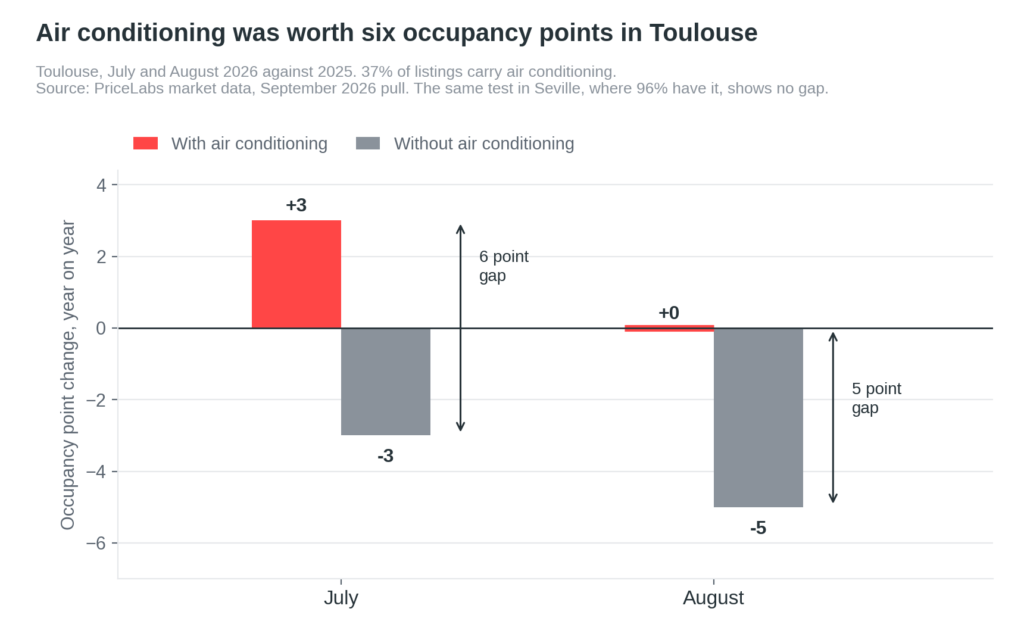
Run the same test in Seville, where 96% of listings are already cooled, and nothing shows up. An amenity stops earning a premium once it becomes the minimum, and in most of southern Europe air conditioning crossed that line some time ago.
The clearest change was in timing rather than destination
September is where the 2026 numbers move most. These figures divide booked nights by the number of properties in the market, because listing counts rose sharply this year and that lifts a total on its own.
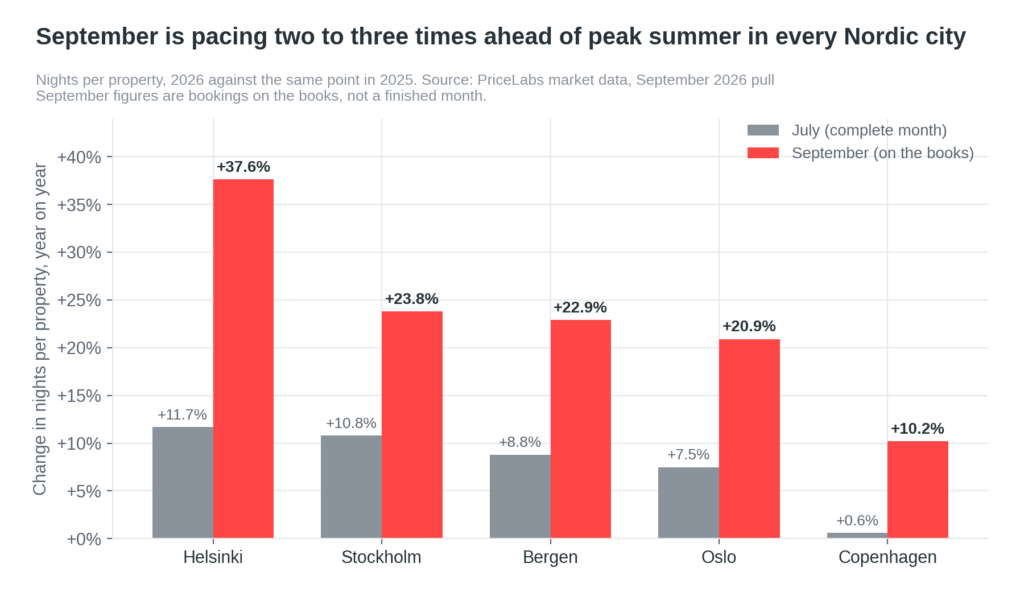
Helsinki has 37.6% more nights per property on the books for September than it had at the same point last year. Copenhagen’s July and August were flat and slightly negative, and its September is still pacing 10.2% ahead, so the September gain does not depend on having had a strong summer.
September is ahead of where it stood a year ago, and not yet ahead of where last September finished. Oslo currently holds 64,147 nights against the 78,334 last September ended with, and Helsinki 24,717 against 29,985. Late bookings usually close most of that gap, so the growth figures describe pace rather than a finished month.
The country data runs the same way. September booked nights are pacing at +28.1% in Italy, +16.6% in Spain and +13.0% in France, against +12.1%, +0.2% and +7.5% for August. The European Travel Commission found 81% of Europeans planning to travel between June and November 2026, four points more than the same window last year, which describes a season getting longer rather than one moving somewhere else.
French hotels see the same move and explain it differently. Alliance France Tourisme, which publishes the MKG hotel panel, reported on 19 August that bookings for the second half of August were running 2 to 5 occupancy points above last year, with September level or slightly ahead and the final week of the month running 2 to 6 points up with most bookings still to come.
Their reading is that this is about budgets rather than weather. Peak summer rates hit historic highs this year, so travellers free to pick their dates moved them later, into the weeks when hotels and rentals cost less. Heat and price push guests the same way, out of peak summer and into the shoulder, which means a host cannot tell from a September booking which of the two brought it.
Why the headline numbers mislead
A public holiday moved out of June
June 2026 held the most intense heat episode of the three, and occupancy fell in six of our seven countries, including every Nordic one: Finland by 3.0 points, France by 1.7, Norway by 1.2, Sweden by 0.9, Italy by 0.9 and Denmark by 0.5. Spain was the only country that rose.
Heat that pushes guests from hot countries to cool ones cannot lower occupancy in both at once. The calendar explains it instead. Whit Monday fell on 9 June in 2025 and on 25 May in 2026, moving the whole Pentecost long weekend out of June and into May across France, Norway, Denmark, Germany, Belgium and the Netherlands. Spain does not treat it as a public holiday, and Spain is the one country in the table that went up. The same mechanism showed up at Easter, when a French school holiday calendar shift left Brittany looking 26% down on demand, which we covered in Easter 2026: Affordable Cities Are Winning. Any French or Nordic host comparing June with June this year is comparing a month with a long weekend against a month without one.
Most of the growth is new listings
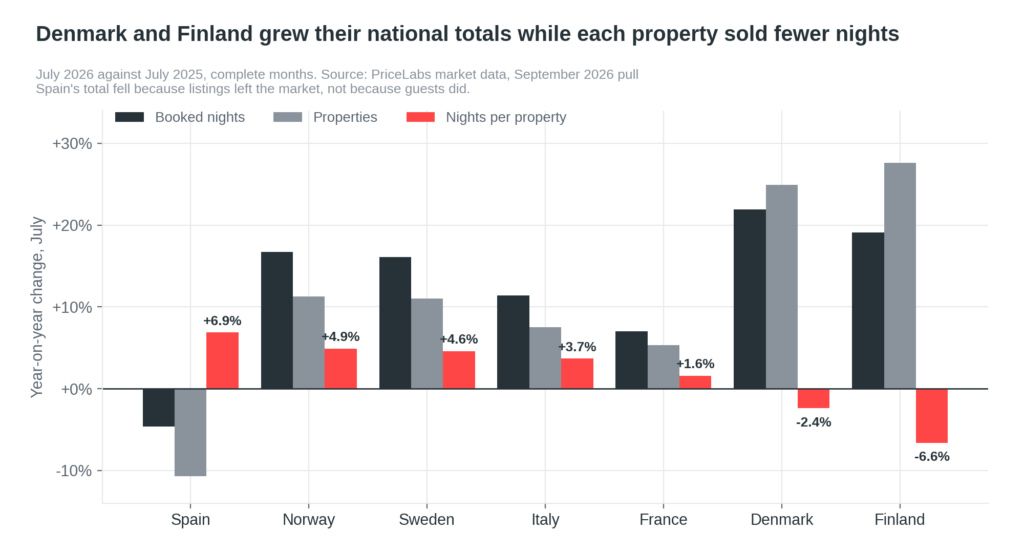
Spain is the only country whose national total fell, and the only one where the average property clearly sold more than last year. Finnish and Danish hosts saw their national totals rise by around 20% while each property sold fewer nights than in 2025.
Denmark’s figures look contradictory and are not. Occupancy rose from 73.8% to 76.3% while nights per property fell 2.4%. The likely explanation is that many of the 24.9% of listings added this year are available for fewer nights each, so occupancy of the nights a host actually opens can rise while the number of nights each property sells goes down.
Oslo shows the same sum at city level: booked nights up 33%, property count up 24%, occupancy up from 51% to 54%. Three quarters of that headline is more properties.
Over two years, no Nordic market sold more nights per property. Finland is down 15.0%, Denmark 8.1%, Norway 2.4% and Sweden 0.8%. The growth came from more listings, so Nordic hosts are splitting the same demand among more competitors than they were two summers ago.
Two rental registries did the rest
Italy’s Codice Identificativo Nazionale, the national code every short-term rental must display, became compulsory on 1 January 2025, with fines up to €8,000 and an obligation on platforms to remove properties without one. Both registries sit inside the wider enforcement build-out we mapped in The May 20 EU Data Deadline. Confcommercio reported that 20% of Florence’s rentals disappeared. Italian listings fell through 2025 and recovered in 2026, so Italy’s 2026 growth is mostly a market climbing back to where it already was rather than a market finding new guests.
Spain’s Número de Registro Único de Arrendamientos, created by Real Decreto 1312/2024, became compulsory for any advertised listing from 1 July 2025. Spain has roughly 45,000 fewer listings this July than last, and that contraction, rather than any loss of guests, is what pulled the national booked-night total down. We covered what the same squeeze did to pricing power on the eclipse route in Spain Solar Eclipse 2026.
Murcia shows why an occupancy gain can mislead
Murcia lost a third of its listings in June and a quarter in July, its booked nights fell about 21%, and its occupancy still rose more than five points in both months. That does not mean anyone in Murcia sold more. The properties that struggled to fill were taken out of the average, so a Murcian host reading their market’s occupancy would see a gain that never reached their own calendar.
Spain sold fewer nights and earned more
Exceltur recorded Spanish tourist spending up 8.2% between April and June. Spending rose while the booked-night total fell, which is a second reason to read Spain’s decline as a supply story rather than a demand one. Exceltur puts the strength down to international travellers redirecting toward Spain because of instability in the Middle East and Spain’s standing as a safe destination, with Turkey down 3.8% and Cyprus down 18.3% over the same period.
What carries over to next summer
Occupancy and booked nights told opposite stories in 2026, and only one of them described what a host experienced. Where listing counts rose, national totals climbed while individual calendars did not, and where a registry removed listings, national totals fell while the surviving properties ran fuller.
Air conditioning earned a premium in Toulouse, where most listings lack it, and none in Seville, where nearly all have it. The value of the amenity tracked its scarcity rather than the temperature outside.
September moved more than any destination did. It moved on a mixture of heat and price, and it moved as pace rather than as a finished month, which is a distinction that matters when the growth rate is read as a result.
June’s decline across six countries was a calendar artefact, and the markets that read it as heat damage were reading a long weekend that had moved to May.

Guneet has spent five years working at PriceLabs, developing deep expertise in short-term rental operations and hospitality technology. She brings that practitioner’s lens to her writing at RSU, covering platform updates and making sense of market data for property managers.
Related Articles:
 Super Bowl LIX New Orleans 2025: The Tightrope of Regulations and Heavy Demand
 Illegal Price Gouging During LA Fires: Airbnb Implements Host Pricing Restrictions
 Vrbo Q2 2025 Results Show Clear Shift Toward Promotions, Shorter Stays, and Bundled Value
 FIFA World Cup 2026: Six Weeks Out, the Demand Environment Is Showing Serious Strain