Airbnb had a good quarter and spent much of the call insisting that no single thing caused it. Brian Chesky said it three separate ways: no silver bullet, no one product, no one partnership.
That is probably true. It is also a useful thing to say when several of the specific changes driving growth are ones hosts have spent the year being frustrated by. The host fee restructure, the payment option that brings more cancellations with it, the hotel inventory now sitting in the same search results: each of those did work for Airbnb this quarter, and each of them lands on hosts in a way the “hundreds of small improvements” framing smooths over.
This piece covers the quarter through what it means for hosts and short-term rental managers.
Highlights
- Revenue: $3.6 billion, up 17%. Up 13% once you strip out currency swings. Nights and seats booked: 148.3 million, up 10%. Gross booking value: $27.2 billion, up 16%.
- Average nightly rate: $183.73, up 5%. Up 7% in both North America and Europe.
- Bedroom nights (nights multiplied by the number of bedrooms): up over 12%, outpacing nights growth. Over a billion in the past year, a record.
- Entire homes with four or more bedrooms: the fastest-growing listing type.
- Reserve Now, Pay Later: more than 20% of everything booked.
- Hotels: still a single-digit share of nights, growing about three times as fast as homes.
- First-time guests: up 11%, the highest in four years, with Gen Z growing fastest.
- App bookings: up 23%, now 64% of all nights.
- Food delivery is coming, through a partner Airbnb has not named yet.
- AI search goes back into testing this month.
- Airbnb is building its own AI pricing model, which Chesky called a bigger growth lever than Reserve Now Pay Later.
The growth looks faster than it really is
Nights and seats booked grew 10%, which Chesky described as picking up speed from the first quarter’s 9%.

Yet, on Airbnb’s Q1 2026 earnings call in May, CFO Ellie Mertz said that without the effect of the conflict in the Middle East, Q1 growth would have been about 10%. Put both quarters on the same footing and the rate is roughly unchanged.
What actually drove the quarter
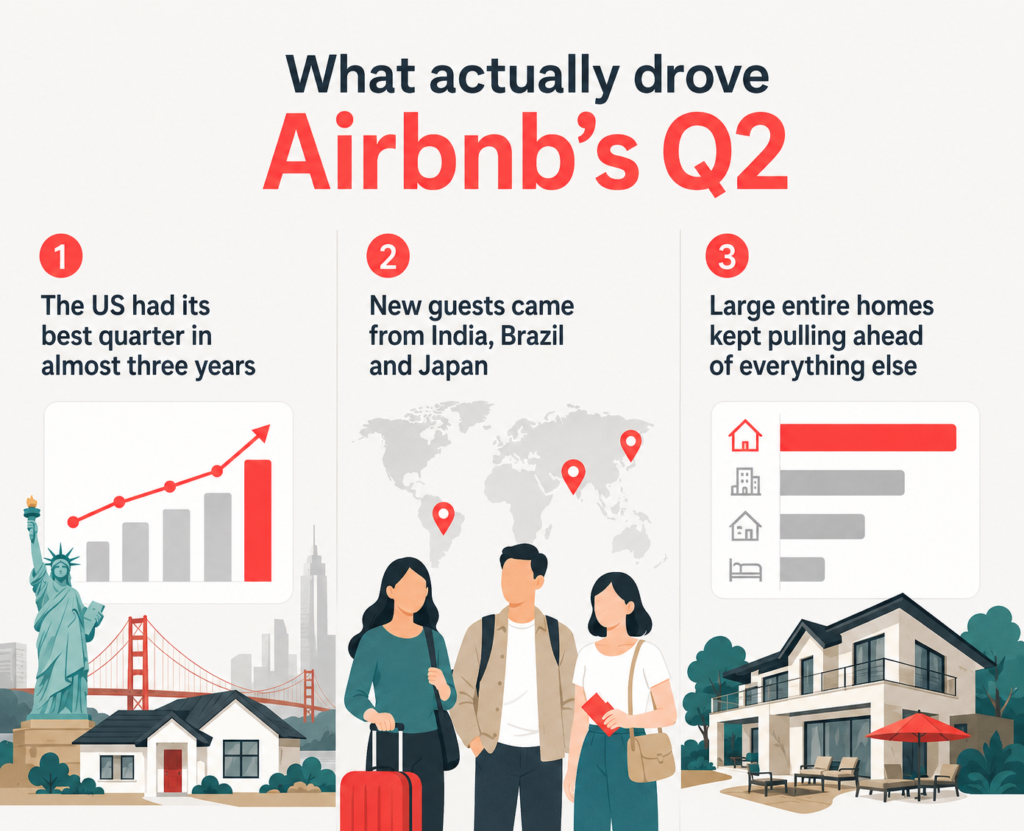
1. The US had its best quarter in almost three years
North America grew nights in the high single digits, which Airbnb called its strongest in nearly three years. Average nightly rates in the region rose 7%.
The World Cup 2026 is one obvious contributor, and Airbnb was an official tournament partner. More than 150,000 homes across host cities were listed for the first time, up from the 100,000 across 16 cities Airbnb reported in May.
It also paid for it. Sales and marketing came to $875 million against $691 million a year ago, up about 27% while revenue grew 17%. Profitability still improved, because support, product and admin costs all shrank as a share of revenue, helped by an AI assistant now handling nearly 45% of customer issues without a person involved. The efficiency is real, and it funded a bigger marketing budget.
Whether the new supply sticks is the open question, and Airbnb has given us a yardstick. In May, Mertz said that six months after the Paris Olympics, Airbnb had kept more than half the listings that came on for the games.
The same playbook now runs at the Olympics, the Tour de France, Art Basel, Lollapalooza, LaLiga and NASCAR.
2. New guests came from India, Brazil and Japan
This is the most directly usable part of the quarter if you are thinking about where inbound demand is building.
- India: trips booked by people based in India grew 60%. First-time guests from the country more than doubled.
- Brazil: up past 30%, with first-time guests up 40%.
- Latin America overall: around 20% growth. Mexico picked up after Airbnb added installment payments in June.
- Japan: high-teens growth, mostly domestic travel.
Airbnb says growth in these markets is running at roughly twice the rate of its core markets, and has been for the past year.
3. Large entire homes kept pulling ahead of everything else
Airbnb leaned on a metric it calls bedroom nights, which is nights booked multiplied by how many bedrooms a listing has. Nights grew 10%. Bedroom nights grew over 12%.
Entire homes with four or more bedrooms grew fastest of any listing type. In North America, short stays and entire homes kept outpacing long stays of 28 days or more and private rooms, continuing a shift that has now run over a year.
I think this number is real and convenient at the same time. Mertz used bedroom nights to argue that rising nightly rates reflect guests booking more space rather than simply being charged more. That argument holds up. It also lets Airbnb claim it is pushing affordability while reporting rising prices, which is a comfortable position to be in. Either way, the signal about what guests are choosing is worth having.
The changes hosts have been uneasy about all showed up in the results
The single 15.5% fee is nearly done rolling out
About half of active listings are now on the single service fee, and Mertz said the whole supply base should be on it by year end.
What is new here is how plainly Airbnb described the intent. Mertz said the single fee puts “a kind of downward pressure on pricing,” framed as delivering value to guests and keeping Airbnb priced competitively against other platforms.
Chesky said property managers connected through software had been “accidentally mispricing because they were pricing on other platforms and our guest fee was going on top of that.”
I don’t think “mispricing” is the right word. There is something real underneath it, which is that pushing one rate across channels that charge fees differently did produce a higher guest-facing total on Airbnb than on Vrbo or Booking.com for the same money to the host. But that is a result of how Airbnb built the fee, not a mistake anyone made. Calling it mispricing puts the problem on the host rather than the structure that created it. What Airbnb is counting on is that hosts lift their displayed rates to cover the 15.5%, which keeps host earnings level and makes Airbnb’s prices look more comparable to everyone else’s.
Airbnb also moved eligible listings from Strict to Firm cancellation policies, a host setting the platform changed on hosts’ behalf. We looked at what looser cancellation terms mean for host exposure earlier this year.
Reserve Now, Pay Later is now more than a fifth of bookings
More than 20% of everything booked in Q2 came through Reserve Now, Pay Later, which lets guests lock in a stay without paying upfront. Airbnb widened eligibility again in July.
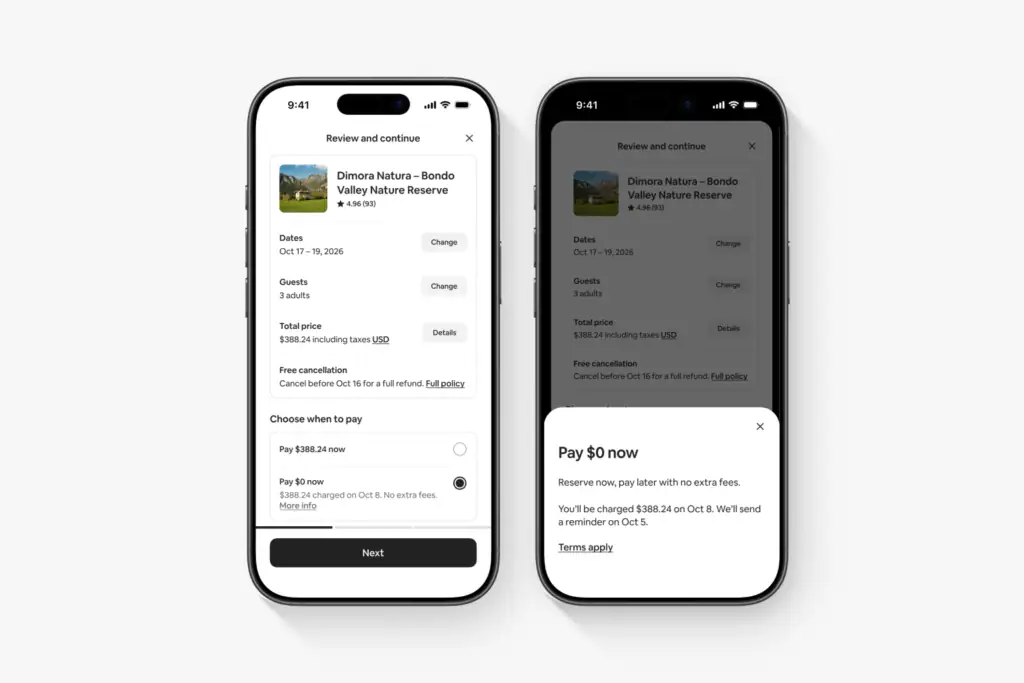
The company credits it with longer booking lead times, higher nightly rates, and more first-time guests who commit more readily when they do not have to pay at the time of booking.
On the Q1 call, Mertz was straightforward about the other side. The programme comes with “a very elevated level of cancellations,” and Airbnb tested it extensively to confirm the overall effect was still positive. But that math is done across the whole marketplace. A single calendar does not average out the same way.
Insurance and paid add-ons are growing fast
Revenue from guest travel insurance, sold in Airbnb’s twelve largest countries, grew over 60% year over year. The company says it has started piloting more insurance products for guests and hosts.
We covered what these add-ons already earn Airbnb on top of your nightly rate, including Earnings Protection and the Extended Cancellation Option.
Airbnb’s cut stayed flat, and the money went to hotels and services
Take rate is the share of each booked dollar Airbnb keeps, worked out as revenue divided by gross booking value.
In May, Mertz said the raised outlook reflected “improvements to monetization through a simplified fee structure and our insurance programs, which are expected to lift our full year take rate.” She told analysts to expect that share to rise in the back half of the year.
It did not. Or not yet anyway. The share was 13.2% in Q2, essentially unchanged from a year ago, and Airbnb now expects it to stay roughly flat all year. The letter gives two reasons: a timing effect from Reserve Now Pay Later, which pushes payments closer to check-in, and higher customer incentives tied to Airbnb’s newer businesses. Without those incentives, the letter says, the share would have been slightly higher.
So the fee change and the insurance products did lift what Airbnb keeps. Something else absorbed it.
I think we can see where it went. Airbnb does not break the incentives out. My read is that they include the hotel offers described in the same letter: the price match guarantee and the credit of up to 15% toward a future booking that featured hotels carry. If that is right, money brought in by the new paid add-ons went toward buying guests for the inventory that competes with homes in the same search results.
Hotels stopped being described as gap-filling
Hotels are still a single-digit share of nights, but hotel nights grew roughly three times as fast as homes. Airbnb has taken supply acquisition beyond cities with tight regulation to a list of about twenty top destinations.
The original pitch was that hotels covered markets where homes could not meet demand. Chesky now says Airbnb is “absolutely going to be stepping on the gas” and is focused “not just on supply-constrained markets, but all markets.”
One hotel number moved a long way. In May, Mertz said over 55% of guests who book a hotel on Airbnb come back to book a home. The Q2 letter puts it at about 35%, and spells out the group it measured: guests who booked a hotel between July 2024 and June 2025 and came back within 365 days. Granted, the May figure came without a stated definition, so the two may not be measuring the same thing. Yet in their current framing, the statements may ring alarm bells for short-term rental operators.
What is coming next
Food delivery, through a partner
Chesky confirmed food delivery as the next service, along with taking grocery delivery international. He was clear it will be a partnership rather than something Airbnb builds, and that this is the point: “Partnerships mean the cost is incurred by the company fulfilling the service, not us. We’re essentially in lead generation for them.”
Car rentals are the biggest service so far by value, and Airbnb was surprised to find rentals running longer than the average stay.
Airbnb has not said who the food delivery partner will be. The pattern so far has been to take the established name in a category rather than build its own: Instacart for groceries, CarTrawler for car rentals.
That second one has aged awkwardly. CarTrawler was bought by Expedia this year, which means the company running Airbnb’s car rental service now belongs to a competitor. Chesky said he expects the partnership to carry on regardless.
My guess is that makes Uber Eats a harder sell. Uber already has a deal with Expedia that puts Vrbo listings inside the Uber app, and handing food delivery to the same company would mean relying on a competitor’s partner for a second service in a row. DoorDash is the obvious alternative for the US. Airbnb has given no signal either way, and the decision may come down to something as dull as which partner covers the most countries.
AI search returns, behind a toggle
Airbnb began testing AI search this month on a small share of traffic. This time the classic search box stays as the default and AI search sits behind a toggle, which is a change from how it appeared when we found it running live in the US in May. Chesky expects months of retraining guests before it moves further.
No white-label distribution
Asked about a business-to-business offering, Chesky said he does not see Airbnb going into white label, because the brand is too strong to strip off someone else’s site.
The question was about serving companies and business travellers, which is a different thing from distributing supply, but his position has held across both quarters: partner for demand while keeping the Airbnb name on screen, as the Delta Miles deal from Q1 does, and refuse to send inventory out anonymously. That runs against where Booking.com and Expedia are heading, since both are building exactly that business.
The next two quarters will settle most of this
Airbnb ends 2026 with every host on the single fee. That will be the first time its prices sit directly comparable against the same listings on Vrbo and Booking.com, with no separate guest charge on either side of the comparison. The World Cup supply will either stay or drift off, and Paris gives us the measure to judge it by, at more than half retained after six months. The incentives currently paying to grow hotels and services will either taper, in which case Airbnb’s cut of each booking rises the way it told investors it would in May, or they will not, in which case the newer businesses are costing more to build than the company expected. A food delivery partner will be named.
None of that is really a question about whether Airbnb is doing well. It is. The open question is how much of the growth runs through decisions hosts did not make and cannot opt out of, and that is the part worth watching quarter to quarter.

Uvika Wahi is the Editor at RSU by PriceLabs, where she leads news coverage and analysis for professional short-term rental managers. She writes on Airbnb, Booking.com, Vrbo, regulations, and industry trends, helping managers make informed business decisions. Uvika also presents at global industry events such as SCALE, VITUR, and Direct Booking Success Summit.
Related Articles:
 Airbnb Courts Occasional Hosts, Promotes Airbnb-Friendly Apartments in New Campaign
 How to Optimize Your Airbnb Listing to Get More Bookings
 A Car Service and a Dinner Party. Airbnb’s Lifestyle Platform Is Arriving in Pieces.
 Airbnb Is Paying UK Hosts to Hit Personalised Summer Targets. What Is the Platform Seeing?