On August 11, 2026, Airbnb and Tripadvisor announced that a “selection” of Viator’s tours and activities will become bookable on Airbnb later this year.
Viator, Tripadvisor’s tours-and-activities booking brand, carries roughly 425,000 experiences. Neither company would say how many will make the cut; a Tripadvisor spokesperson told PhocusWire they had “nothing further to share beyond the blog post.” A small detail worth noticing: the press release lives on Tripadvisor’s site, quotes only a Tripadvisor executive, and has no counterpart on Airbnb’s newsroom. Each company, it seems, knows which part of this deal it would rather talk about.
That single word, selection, is the whole story. Airbnb has built what may be the best-placed sales spot in online travel, a trip page that knows the guest’s dates, address and party size, and it has too little to put on it.
Viator has the product and needs the distribution; Airbnb needs options while it slowly builds its own program in key markets. A year ago, reviewing the relaunch, we called Airbnb’s rebuilt Experiences “promise, not performance”. The screenshots below, which nobody else has published, show how little has changed and what this deal is really for.

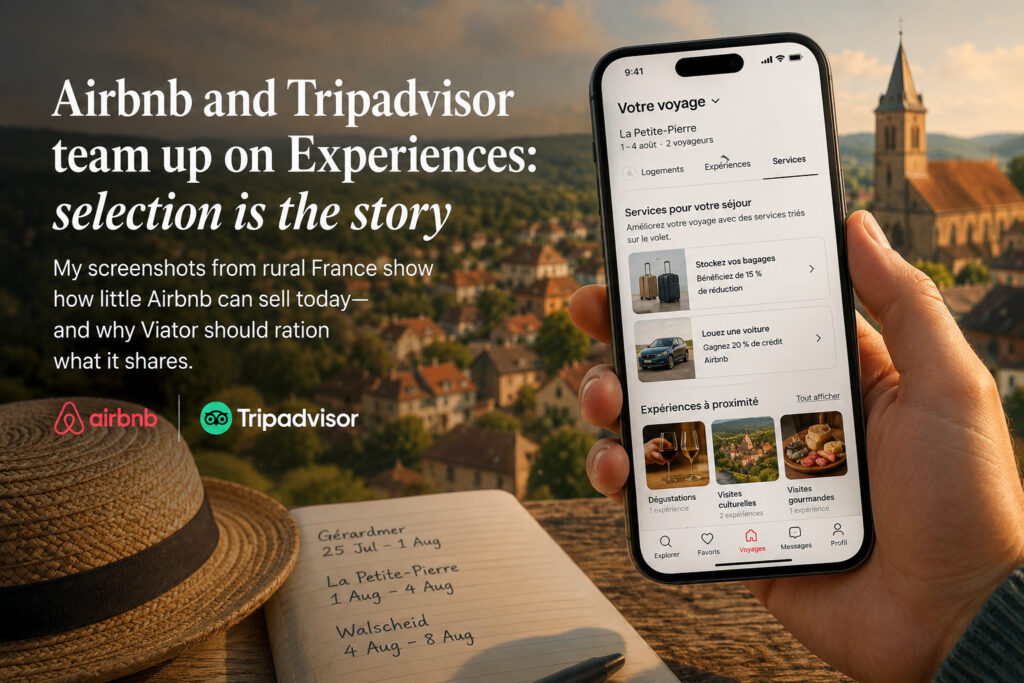
Two weeks before the announcement, in the last days of July, I was traveling through eastern France with three consecutive Airbnb bookings, and I screenshotted every screen where Airbnb tried to sell me something. My own trip page offered one massage, one private chef, and a six-wine tasting an hour’s drive away. Those screenshots are the before picture: what Airbnb can actually sell a guest today, in a real account, without Viator.
In this article, I will walk you through those screens, then argue why Airbnb needs this deal badly, why it suits Viator just as well, and what the “selection” will probably look like.
Key takeaways
- My screenshots, taken two weeks before the deal was announced, show both sides of it: a trip page that puts paid offers above the guest’s check-in details, and, in a French village, four service categories with one or two providers each plus three tours all an hour’s drive away. The best-placed sales spot in online travel, with too little to sell.
- This is a classic distribution deal, not a turf war. Viator already resells through Booking.com and needs more distribution: its Experiences profit fell 19% last quarter even as revenue grew 3%. “Selection” likely means Airbnb curating for brand fit, not Viator holding back.
- Our expectation, and it is only that: a two-tier storefront by design. Airbnb keeps building its one-of-a-kind, keynote-friendly experiences in key markets; resold volume fills in behind, the Louvre tickets and Seine cruises people actually buy.
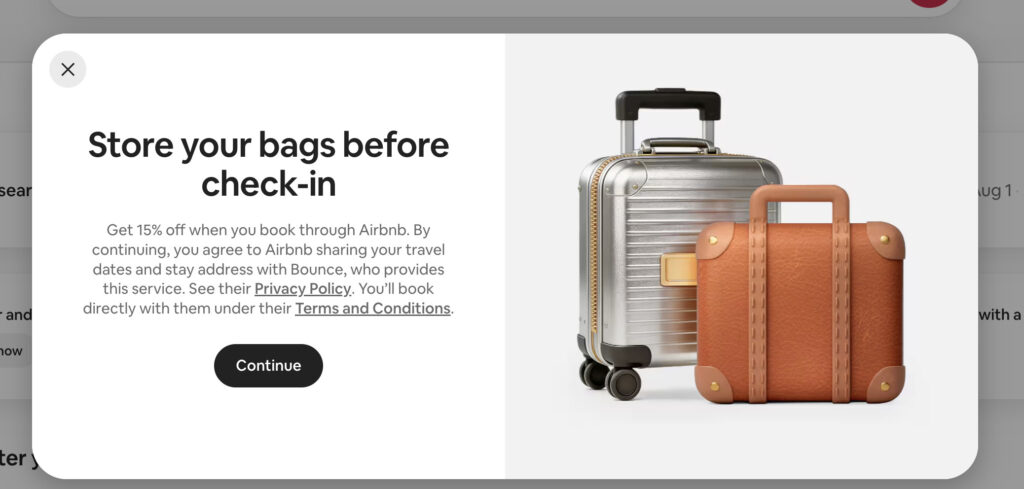
- The template for the deal is already on screen: to get 15% off luggage storage, the guest agrees that Airbnb shares their travel dates and stay address with the partner. The partner does the work; Airbnb keeps the guest.
- For managers, the fight is not over generic tours. It is over the fifteen-minute radius that no OTA catalog covers, and city managers have about a season to reprice their concierge service.
What I saw, screen by screen
My bookings: Gérardmer from July 25 to August 1, then La Petite-Pierre from August 1 to 4, then Walscheid from August 4 to 8. Two guests, three stays back-to-back. For readers outside Europe: this is rural eastern France, in the Vosges mountains and northern Alsace near the German border, villages and small spa towns rather than a tourist metropolis. Strasbourg, the nearest large city, is about an hour away by car. The app was set to French, the website to English.
The homepage already knows where I am going
On the logged-in website, under “Welcome back”, Airbnb showed my upcoming trips next to two offers: “Rent a car and earn 20% in Airbnb credit”, and “Get 15% off luggage storage in La Petite-Pierre“, named for the village I had booked rather than anywhere I had searched.
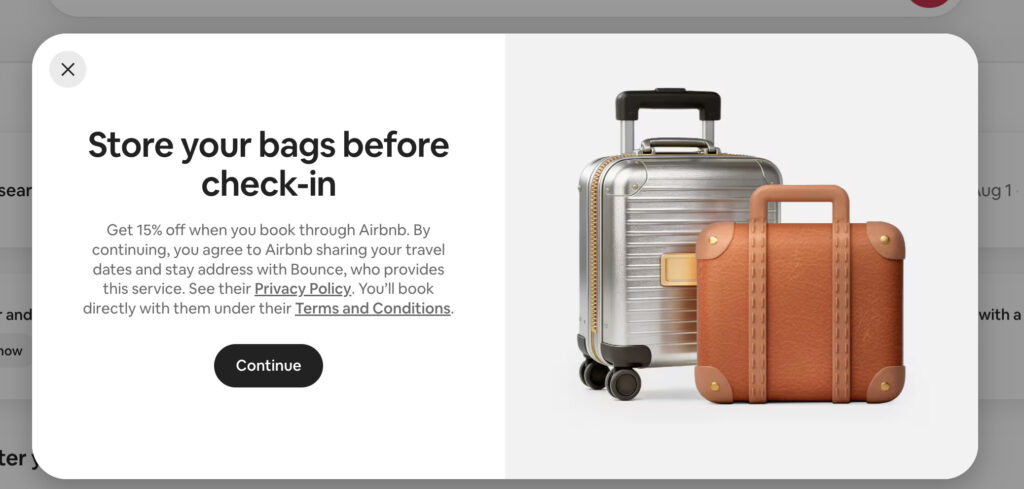
Then a full-screen pop-up interrupted the page: “Store your bags before check-in.” We will come back to what that pop-up actually asks the guest to agree to, because it matters more than the discount.
In the app, Services is now a storefront
The app’s main navigation now reads Logements / Expériences / Services (Homes / Experiences / Services). Below it, a row of experience categories for Gérardmer: Dégustations (tastings), Visites culturelles (cultural tours), Visites gourmandes (food tours).
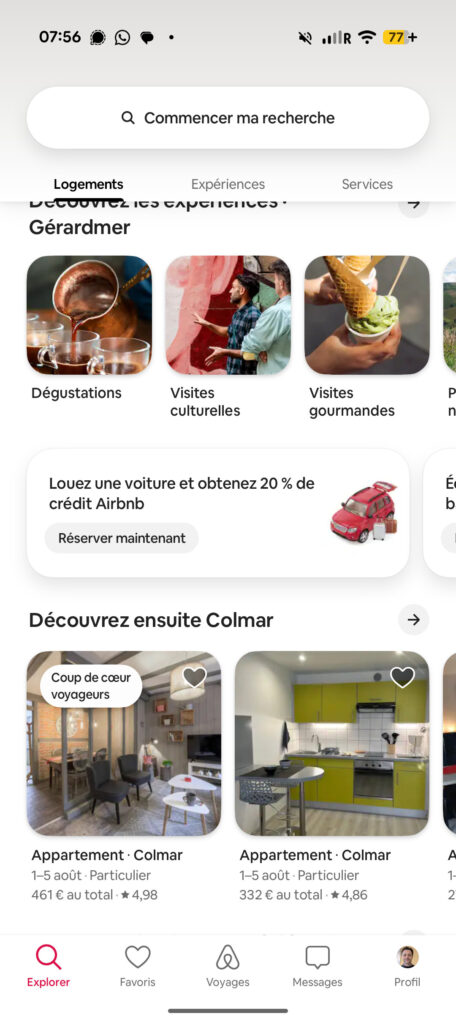
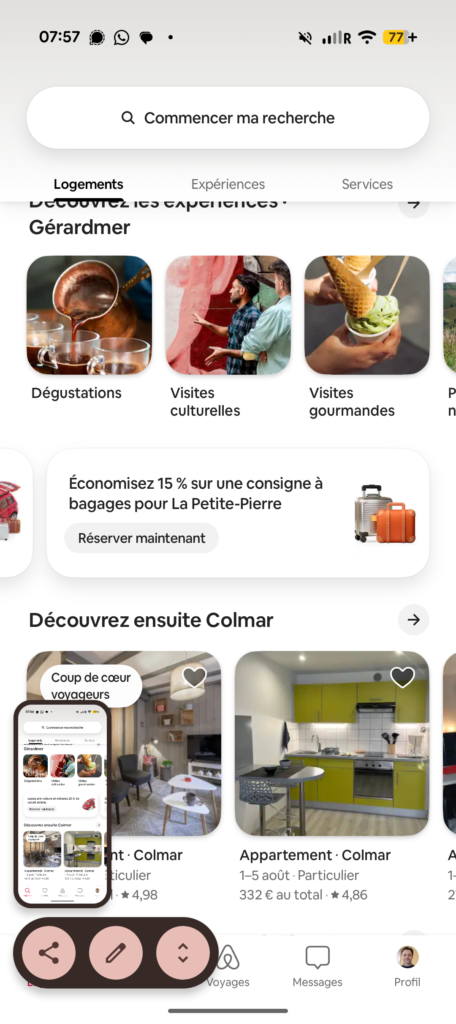
The same two offers from the website, car rental and luggage storage, reappear here as swipeable cards between the content rows. By this point, I had seen them on three different screens, always with a village name pulled straight from my booking.
Then a row headed “Découvrez ensuite Colmar” (Discover Colmar next) offered me two Colmar apartments for August 1 to 5, at €461 and €332 total. Look at the dates. All four of those nights were already booked and paid for on my account, three in La Petite-Pierre and the fourth in Walscheid. Airbnb was advertising me homes for nights it had already sold to me. The next-trip row reads my region and my dates, but evidently not my own calendar.
The trip page is where the money is
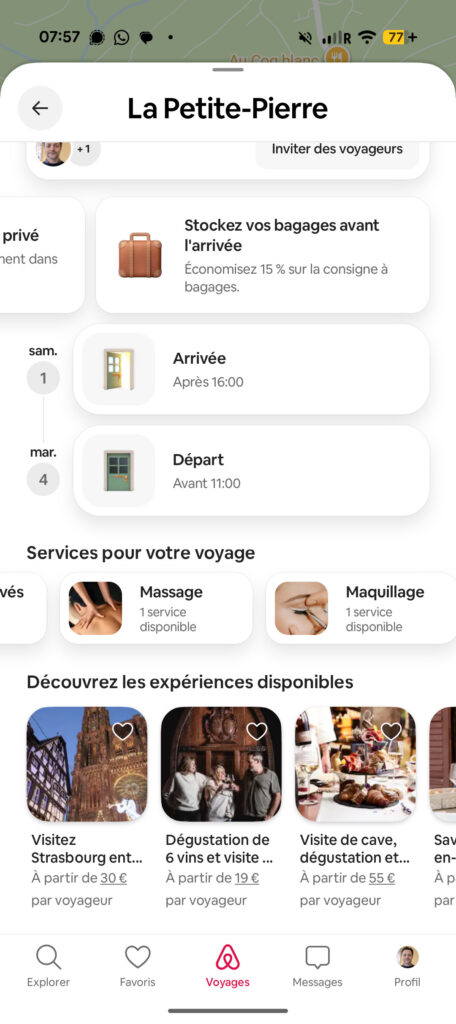
Tapping into Voyages (Trips) opens a map of my stay with restaurant pins, and a card slides up headed “La Petite-Pierre.” From top to bottom: my reservation (“Mon séjour”, the host’s first name, 1–4 août, a button to invite fellow guests), then a row of paid offers (car rental with 20% credit, private transfer, luggage storage at 15% off), then the itinerary. Two rows: check-in Saturday after 16:00, check-out Tuesday before 11:00. Nothing between them.
Below the itinerary, “Services pour votre voyage” (Services for your trip): Photographie, 2 providers; Chefs privés, 1; Massage, 1; Maquillage (makeup), 1. Then “Découvrez les expériences disponibles” (Discover the available experiences): a Strasbourg city tour from €30 per traveler, a six-wine tasting from €19, a cellar visit from €55.
Here’s the thing: that list of extras is neither empty nor fake. It is thin, and it is in the wrong place. La Petite-Pierre is a village of a few hundred inhabitants. The three tours are real and genuinely Alsatian, but each sits about an hour’s drive from the house, and they are exactly the kind of product Viator sells hundreds of thousands of. Airbnb’s own hosted-experiences model, which Chesky has championed personally since 2016, produced one wine tasting an hour away. Viator’s catalog would produce dozens.
Why Airbnb needs this deal: the placement is too good to leave thin
Look again at the order on that trip page. The row of paid offers sits above the itinerary, not below it. Airbnb put a commercial break between me and the two pieces of information I had opened the screen to find.
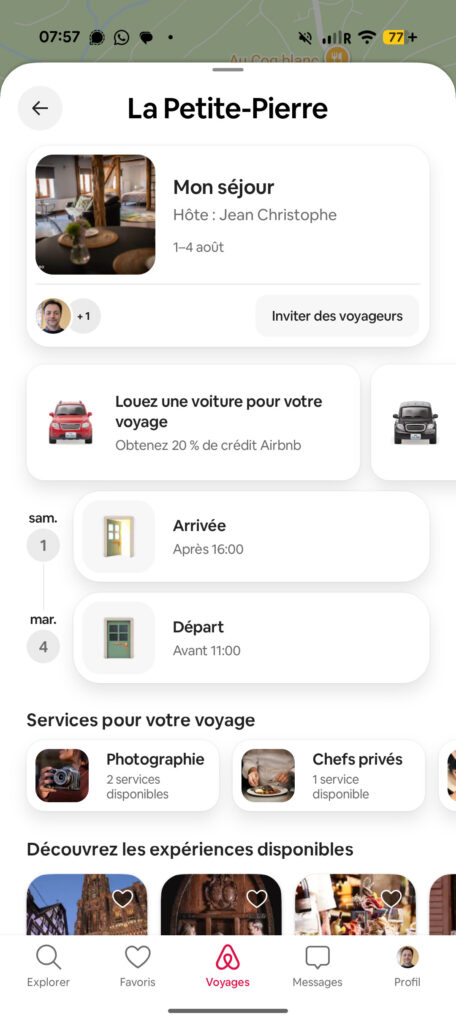
And the itinerary it interrupts is three nights of blank space presented as a timeline, with the services and experiences listed directly beneath. Airbnb has redesigned the post-booking screen so the guest sees a gap and the platform sells the filler.
No other seller in travel gets a spot like that. Airbnb knows my dates, my address, my party size, that I have already paid, and that my Sunday is empty. No search engine, no metasearch, no email campaign reaches a traveler in that state. Viator, by contrast, mostly reaches people who are still Googling.
Airbnb has therefore built the best place to sell a tour, and it has very little to sell. And that is not a new problem: the program launched in 2016, was paused during the pandemic, and only reopened host applications in late 2024 after a freeze of a year and a half. The 2025 relaunch is not a failure; it is running into what everyone in this industry already knows: this category is brutally hard to scale by hand. Skift reports that it reached roughly 3,000 landmark experiences across 100 cities before the company narrowed its focus to Paris. Chesky told analysts on the Q2 2026 earnings call that Experiences will grow quickly “when we take that and industrialize it to thousands of markets, and that’s not this year.”
And as it rolls out more extras, Airbnb has tasted how fast the partner route scales by comparison: one deal with Welcome Pickups brought airport transfers in more than 160 cities, one deal with Bounce brought some 15,000 luggage-storage points. Recruiting experience hosts one by one cannot compete with that. Buying supply through a partner is how a company skips the “not this year”.
A distribution deal that suits both sides
Now take the seat on the other side of the table. If you run Viator, listing your tours on Airbnb is not a painful concession; it is the business you are in. Viator already pushes its supply through rivals: last October, Booking.com added more than 150,000 attractions through FareHarbor’s distribution network, with Viator among the named providers. As we noted then, attractions and experiences are becoming a core battleground for OTAs racing to capture value beyond the stay. In the big cities, Viator does not need to protect its inventory from Airbnb; it needs more places to sell it. The fact: Tripadvisor’s Experiences revenue grew 3% last quarter while the segment’s operating profit fell 19%, marketing spend rose to $215.4 million, and the company is selling its restaurant-booking arm TheFork to American Express for $700 million as it reshapes itself around experiences. Our interpretation: a sales channel that costs nothing in marketing is exactly what a company in that position wants.
Whether the tours will carry Viator’s name on Airbnb is, frankly, a detail. This can be an affiliate deal or a white-label feed; who cares. Consider how Airbnb already presents partners: the services list on my trip page reads “Photographie, 2 services disponibles.” No supplier brand, no operator name, just a category and a count. Bounce and Welcome Pickups accepted that anonymity because the booking moment is worth more than the byline, and Viator will likely make the same trade.
The economics are the standard partner playbook. The car rental card promises 20% back in Airbnb credit, redeemable against a future stay, experience or service, and management was candid on the Q2 call about who pays for the rest: “Partnerships mean the cost is incurred by the company fulfilling the service, not us.” Airbnb brings the guest and the moment, funds loyalty with credit, and carries none of the fulfilment cost.
The luggage pop-up from the homepage shows the template. To get the 15% discount, I had to agree that Airbnb would share my travel dates and my stay address with Bounce, the storage provider. The platform brokers the data and the partner does the work; the guest relationship stays with Airbnb.
When the Welcome Pickups transfer deal landed in April, we described Airbnb’s platform logic as “curate and distribute, don’t operate”. The Viator deal applies that logic to the biggest category yet. For managers, this is the most useful lesson in the whole story: in these deals, the party with the supply gets the volume, and the party with the guest keeps the relationship. Ask which side of that trade you are on.
To be fair to both parties, neither has disclosed commission terms, market scope or volume, and Tripadvisor declined to comment beyond its blog post. Everything above is read from the incentives, not from a briefing.
We at Rental Scale-Up read the word “selection” as Airbnb’s curation, not Viator’s rationing. Expect Airbnb to trim whatever clashes with its brand and take the rest, because the plan only works with depth.
And the plan, as we see it, is a two-tier storefront. Airbnb is a cash machine, but it is also a PR machine. It will keep building the layer it can talk about: one-of-a-kind experiences with vetted hosts and the occasional celebrity moment made for a keynote, concentrated in key markets, growing slowly, because handpicked supply cannot grow any other way. Resold volume fills the shelves behind: the Louvre and Eiffel Tower tickets, the observation deck of the Empire State Building, the theme park entries, the usual tourist fare. Not the sexiest supply, and probably not the highest margin, but it is what people actually buy, and it is what stops a trip page from looking as empty as mine did.
The cultural shift matters as much as the commercial one. Airbnb spent a decade telling guests to live like a local, with a hint of judgment about the tourist classics. Selling the Seine cruise next to a workshop with a real painter, who taught the way portraits were done in the 18th century, means dropping that judgment. A tourist buys the ticket; the self-described traveler books the workshop. A marketplace sells to both.
And filling holes in its own supply is not a new reflex for Airbnb. When the company started talking up hotel rooms, the logic was the same: hotels plugged the markets where Airbnb had too few homes, so that a searching guest was never left empty-handed. The first rule of a marketplace is to have supply. Viator is that same move, applied to experiences.
The test to watch, then, is not who won a negotiation. It is how Airbnb presents the two layers on the page: whether its own experiences get a distinct label while the resold tours sit behind them, and how fast real depth arrives outside the marquee cities. Viator’s catalogue is city-heavy too, so my Alsace village may stay thin for a while yet.
What it means for property managers
- The list of experiences on your guest’s trip page is about to get longer, though probably not in rural markets first. If you operate in a city, assume it fills up this year. If your market looks like mine did (see the screenshot above: four categories, one or two providers each), you have more time than the headline suggests.
- Airbnb is turning generic tours into interchangeable products. Whatever Viator ends up supplying will be priced, reviewed and sold on that trip page at Airbnb’s moment, not yours. You will not win that one. What you can win is the fifteen-minute radius: the producer down the road, the guide who answers your call, the thing that appears in no OTA catalogue.
- Airbnb’s partner-first turn covers services as well as tours. Bounce for luggage, Welcome Pickups for transfers, Instacart (the US grocery-delivery platform) for shopping, now Viator for experiences. Back in April, previewing the Summer Release, we warned that Airbnb was “systematically platforming the services professional property managers already provide”; tours now join that list. Airbnb supplies the guest and the moment; the partner supplies the product and stays invisible. Ask which of those two roles your own business is currently playing.
So, is this a threat or an opportunity? For managers in dense tourist cities, your concierge margin is what is at risk, and you have this season to decide what you charge for it. For everyone else, it is a deadline rather than a loss.
Now, as usual, what matters is your own market. Open Airbnb as a guest with dates in your destination, scroll down to the available experiences, and count them. Do it this month, and again in December. The difference between those two counts is how much time you have.

Thibault Masson is a leading expert in vacation rental revenue management and dynamic pricing strategies. As Head of Product Marketing at PriceLabs and founder of Rental Scale-Up, Thibault empowers hosts and property managers with actionable insights and data-driven solutions. With over a decade managing luxury rentals in Bali and St. Barths, he is a sought-after industry speaker and prolific content creator, making complex topics simple for global audiences.
Related Articles:
 Airbnb Rolls Out Co-Host Network, New Host Tools, and Intensified Guest Personalization
 How Airbnb Is Using Superhosts to Keep Hosts Engaged and Loyal
 Booking.com’s Foundations Score, Vrbo’s Useful AI Chatbot, and Airbnb’s January 18 Booking Peak: the OTA Panel at Short Stay Summit 2026
 Airbnb’s Hotel Strategy in 2026: What the Q1 Earnings Call, Hiring Data, and HotelTonight Tell Us