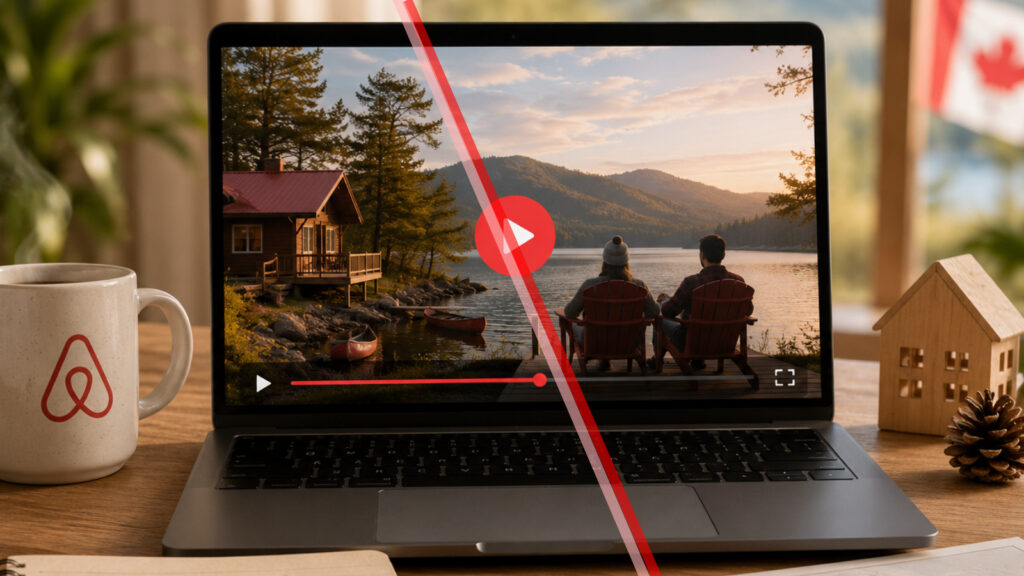
Airbnb released four new ads featuring Canadian markets this month. Interestingly, not one of them is set in Toronto, Vancouver, or Montreal, the three cities where Canada has capped short-term rental supply hardest.
The showcasing of these specific markets in the commercials is not a coincidence. Where a platform spends brand money tells you where it still expects to grow. Below is what happens in each ad, every business that appears in them, and what Airbnb’s choice of markets says about its plans for Canada.
Four New Airbnb Ads Showcase Four Canadian Markets
Four videos went up on Airbnb’s YouTube channel, each running about thirty seconds. Three are in English, one is in French.
They cover Picton in Prince Edward County, Ontario; Dunham in Quebec’s Eastern Townships; Kelowna, British Columbia; and Halifax, Nova Scotia. The timing is August, at the start of shoulder season and about a month after the FIFA World Cup ended in Toronto and Vancouver.

Every ad follows the same template. A Polaroid-style snapshot introduces the host. The host heads out to two or three independent local businesses, talks about the community, and waves goodbye at the door. The closing card reads: with Airbnb, you book the neighborhood.
Each Ad Casts the Host as a Guide to Local Businesses, Not as a Property Owner
In all four videos, the host never talks about their listing. They talk about the shops, restaurants, and studios around it, and about the people who run them.
“Welcome to Kate’s Picton, Ontario”
Airbnb host Kate heads to Cylinder Shop, a pottery studio and store, where she throws a pot at the wheel and browses finished ceramics. Quick cuts show local produce and grilled vegetables. She then walks Picton’s main street to Books & Company, an independent bookstore.
Kate’s narration is the most community-focused of the four. She says Prince Edward County is open to artists, that there is craft in the county from the makers to the farmers, and that it matters to her that guests see the people who make the community whole.
“Bienvenue dans le Dunham de Richard, au Québec”
The only French ad, set in Dunham, a small town on Quebec’s Route des Vins.
Airbnb host Richard visits La Bodega, a Spanish tapas restaurant with stone walls and a rustic dining room, then Les Trois Âcres (Three Acres Honey Farm), where the ad shows the hives and the shop.
Richard’s narration is the most economic of the four. He says Dunham’s economy is resilient because everyone helps each other, compares the town to a beehive, and then spells out a chain of local spending: the honey goes into the local beer, and the beer brings in visitors.
“Welcome to Deanna’s Kelowna, British Columbia”
Airbnb host Deanna shops the Kelowna Farmers’ and Crafters’ Market, talking to a florist and browsing produce, baked goods, mushrooms, and preserves. She explains the market’s local-only rule: to sell there, you have to make it, take it, or grow it.
She then stops at Parlour Ice Cream, which uses local strawberries, cherries, and blueberries, and eats her cone at the lakefront.
Deanna’s narration positions the host as a referral channel. She says that when she sends her guests to the market, she knows they will have a good time.
“Welcome to Katie’s Halifax, Nova Scotia”
Airbnb host Katie introduces herself with her dog, then goes to Rousseau Chocolatier, home of the chocolate lobster, which she calls the local secret hiding behind the region’s obvious specialty. She has coffee and a breakfast sandwich at The Osney Café & Social, and finishes with a yoga class at a local studio.
The Campaign Reuses Two Templates Airbnb Has Run Before
Airbnb is not exactly reinventing the wheelhouse with these ads. The campaign combines two formats Airbnb has already used, and it repeats a pivot the company made once before under pressure.
Live There, 2016
Airbnb’s biggest brand campaign to that point told travelers not to “do” Paris but to live in it, and pushed people away from standard sightseeing toward ordinary neighborhood life. It shipped alongside an app update that added guidebooks written by hosts, which turned local recommendations into a product feature.
Go Near, 2020
When the pandemic killed long-haul travel, Airbnb reworked its app and homepage to surface nearby getaways, ran a summer email and social campaign under the Go Near banner, and paired it with tourism board partnerships framed around local economic development, citing an estimated $117 billion in economic impact from its community in 2019.
The 2026 Canadian campaign runs the same play. A shock pushes travel inward, Airbnb pivots to small-town domestic trips, and frames the pivot around local economic contribution.
Made Possible by Hosts, 2021
Airbnb turned guests’ own trip photos into montages set to licensed music, thanking hosts for the memories. It ran in Canada, among other markets.
Airbnb Consistently Presents Its Supply as Individual Locals
Across all three campaigns and every year in between, Airbnb’s public picture of who lists on it has stayed consistent. The host owns one home, lives in the community, knows the neighborhood, and wants to share it.
That picture leaves out most of the supply that actually drives Airbnb’s growth. Professional property managers and multi-listing operators run a large share of the inventory, and Airbnb has spent recent years actively courting them, along with hotels. None of them appear in these ads, and none of them have appeared in any Airbnb brand campaign for years.
Airbnb Has Four Reasons to Keep the Small Host at the Front
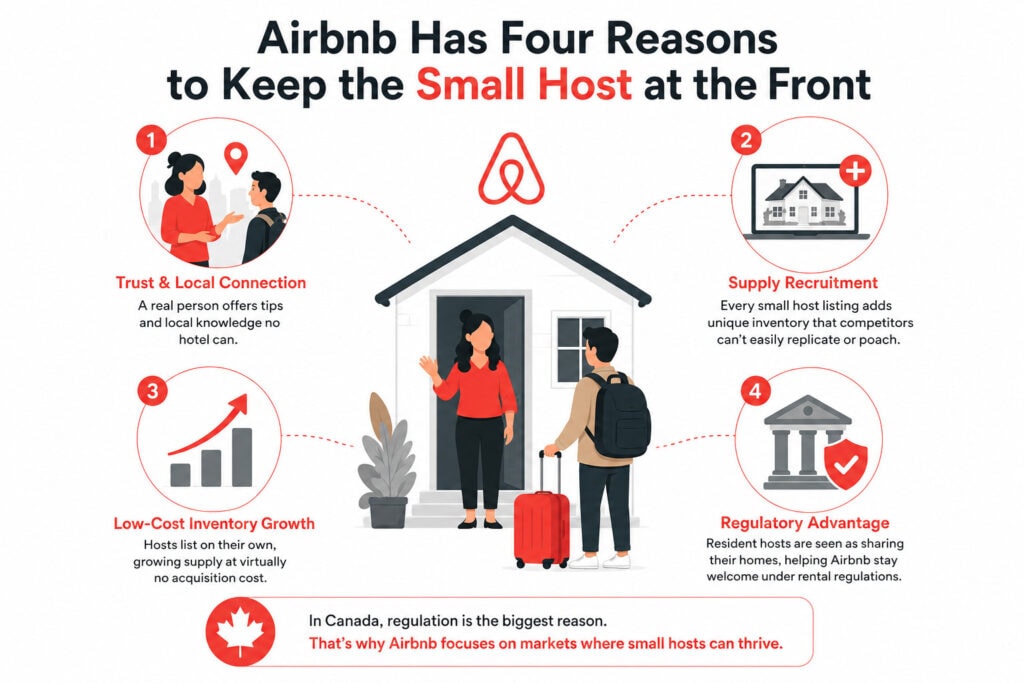
- Hotels cannot copy it. A hotel can match the bed, the price, and the location. It cannot offer a neighbor who tells you where the chocolate lobster is.
- Trust. Guests are booking a stranger’s home rather than a branded property. A person’s face lowers the perceived risk in a way a listing photo does not.
- Supply recruitment. Every small host who lists is inventory that competitors find hard to poach and that costs Airbnb nothing to acquire.
- Regulation. Councils write short-term rental rules based on whether they read the activity as residents sharing homes or as investors removing housing stock. The resident host is the only version of Airbnb that survives that debate.
It is this last reason that matters most in Canada, and it explains the choice of markets in this campaign.
Every Market in the Campaign Is One Where the Rules Already Favor the Owner-Occupier Host
Line the four markets up against local regulation and a pattern falls out:
- Prince Edward County stopped issuing new licences for secondary residences for any application filed after September 20, 2022. However, residents can still license the home they live in and rent it for up to 45 days a year. (County of Prince Edward)
- Halifax allows whole-home short-term rentals in residential zones only in a host’s primary residence. Anything else needs commercial or tourist zoning, on top of Nova Scotia’s provincial registration. (Halifax Regional Municipality)
- Quebec requires CITQ registration for every short-term rental. In Montreal, hosts can rent their principal residence only between June 10 and September 10, and three boroughs ban it outright. Smaller Quebec markets like Dunham face nothing close to that. (Ville de Montréal)
- Kelowna became the first BC municipality to opt out of the province’s principal residence requirement, effective June 1, 2026, for properties in the city’s short-term rental subzone. (BC Gov News)
In three of the four, the owner-occupier host is the only legal option. In the fourth, the rules just loosened. Every host on screen is the host their local council has already agreed to allow.
That explains the type of host. The demand picture explains the timing.
Canadians Stopped Traveling to the US, and Airbnb Cannot Absorb That Demand in Its Biggest Cities
Canadian travel to the US collapsed in 2025 and has not recovered. Statistics Canada recorded 15 straight months of year-over-year decline through March 2026, with return trips from the US that month down 28 percent against March 2024. Full-year 2025 travel to the US fell about 25 percent. Air Transat suspended its US routes for summer 2026 entirely. (Statistics Canada)
Meanwhile, Canadian return trips from overseas kept rising, and for three consecutive months they outnumbered car trips back from the US, which had not happened since records began in 1972 outside the pandemic.
That money did not vanish. A large share stayed in Canada, and it is the biggest redirection of Canadian travel spending in decades. A platform would normally capture a windfall like that in Toronto, Vancouver, and Montreal. Airbnb largely cannot, because supply in those cities is capped at owner-occupied homes and, in Montreal, at three months of the year. So the growth has to come from somewhere else, and these four ads may be that somewhere else.
Kelowna Loosened Its Rules in June and Got an Airbnb Ad in August
Of the four markets, Kelowna is the one that changed recently.
The city opted out of BC’s principal residence requirement on June 1, 2026, after asking the province to move the date up ahead of a busy summer events calendar. Roughly two months later, it is one of four Canadian markets getting Airbnb brand video.
Airbnb has not linked the two, and neither do we. But the sequence is useful to the company at the next council table in Canada: loosen the rule, and the platform arrives with visitors and free marketing for your local businesses.
The Ads Never Mention Money, the Home, or Hosting
Here is what is missing from all four videos:
- No nightly rate, no discount, no prompt to book
- No mention of the home itself, its bedrooms, its amenities, or its design
- No mention of hosting income, second incomes, or paying a mortgage
- No AirCover, no Airbnb Setup, no host-facing product at all
- No invitation to list a property
Compare that to Airbnb It in 2023, built specifically to recruit hosts by defusing nerves about letting strangers into your home, or to Airbnb’s own World Cup push earlier this year, which offered roughly $1,000 CAD to new entire-home hosts across the 16 tournament cities.
In Canada in 2026, anything that reads as “list your investment property” becomes a housing story within a day. Take out everything that sounds like an ask, and one claim survives: Airbnb brings paying customers to your main street. That is why a host in Dunham explains that honey feeds the local brewery and the brewery brings in visitors. Nobody talks like that in a travel ad unless the economic argument is the ad.
The Businesses in the Ads Work in November, Not Just July
Let’s look at what Airbnb chose to film: a chocolate shop, two cafés, a yoga studio, a bookstore, a pottery workshop, a tapas restaurant, and a honey farm.
Nearly all of it is indoor and open year-round. The only summer imagery in the entire set is the Kelowna lakefront and the farmers market.
Airbnb spent the first half of 2026 recruiting new Canadian hosts around the World Cup, which ran in Toronto and Vancouver and ended in July. Those hosts are heading into their first shoulder season now, and this campaign points at the months after the tournament rather than during it.
What This Means
Airbnb has marked four Canadian markets as worth brand investment heading into autumn, and all four sit outside the metros. Its Canadian growth now lives in secondary cities, wine country, and coastal towns.
The pattern repeats outside Canada. When a city caps supply, Airbnb does not fight the cap in its advertising. It moves the advertising somewhere the rules already work, and narrows its public case for short-term rentals to the host who can plausibly be called a neighbor.
For operators, that makes the ads a leading indicator. Where Airbnb spends brand money is where it expects demand it can legally serve. Where it goes quiet is worth reading too.

Uvika Wahi is the Editor at RSU by PriceLabs, where she leads news coverage and analysis for professional short-term rental managers. She writes on Airbnb, Booking.com, Vrbo, regulations, and industry trends, helping managers make informed business decisions. Uvika also presents at global industry events such as SCALE, VITUR, and Direct Booking Success Summit.