President Trump, the French football team, FIFA, America’s 250th birthday, and your booking calendar: all of them land on the same Saturday, July 4, 2026. President Trump will speak on the National Mall in Washington, D.C. Kylian Mbappé and France will play Paraguay in Philadelphia in a World Cup Round of 16 match, a few hours after the city buries a one-ton time capsule next to Independence Hall.
If you manage short-term rentals and could not care less about football, or if you operate in Europe and feel this is an American story, stay with me. This weekend is a rare, clean case study in what happens when two very different types of demand — one predictable for, literally, 250 years, and one decided by a penalty shootout ten days before check-in — land on the same market, on the same night. In this article, we’ll look at what the booking numbers show, what has changed since they were collected, and what it means for how you price such events, wherever you are.
Key takeaways
- Philadelphia’s occupancy for the July 4th weekend is up 25% year-over-year even though the city added 27% more listings. Its growth in ADR (average daily rate) is +84%, the highest of the markets PriceLabs measured.
- Williamsburg, with pure anniversary demand and no stadium, shows occupancy up 54% but rates up only 16%. The ADR gap between the two cities is, in our reading, the football premium.
- The numbers were pulled on June 18 — before Paraguay eliminated Germany and before France qualified for the Philadelphia match. The last-minute wave lands on top of these figures, not inside them.
- Atlanta and Seattle look strong on booked nights but are harder to fill than last year, because listing supply grew faster than demand.
- The lesson travels: Euro 2028 in the UK and Ireland, and the 2030 Winter Olympics in the French Alps, will create the same collision of demands in Europe.
FoR NON-US readers: what exactly is happening on July 4th?
July 4, 2026 marks 250 years since the Declaration of Independence was adopted in Philadelphia, in 1776, at what is now called Independence Hall. Americans call the anniversary the Semiquincentennial — simply put, the country’s 250th birthday. And because the founding document was signed in Philadelphia, that city, not Washington, D.C., is the symbolic capital of the celebration.

Several layers of events are stacking on that one day:
- America250, the nonpartisan organization created by the US Congress to run the anniversary, buries “America’s Time Capsule” — a one-ton vessel with contributions from all 50 states, to be opened in 2276 — at Independence National Historical Park at 8:30 a.m.
- Wawa Welcome America, Philadelphia’s free city festival, has been running since June 19 and peaks on July 4 with a concert and fireworks on the Benjamin Franklin Parkway. (Wawa is a Philadelphia-area convenience store chain — imagine a national holiday festival named after a local supermarket. In Philadelphia, it works.)
- President Trump holds his own July 4th address on the National Mall in Washington, D.C., billed as the centerpiece of the federal celebration; the State Department runs a separate program called Freedom250. So the US capital has its own demand layer, distinct from Philadelphia’s.
- FIFA World Cup 2026: France vs. Paraguay, Round of 16, kicks off at 5 p.m. at Lincoln Financial Field (renamed “Philadelphia Stadium” for the tournament).
Philadelphia: a date known for 250 years meets a match decided ten days before kickoff
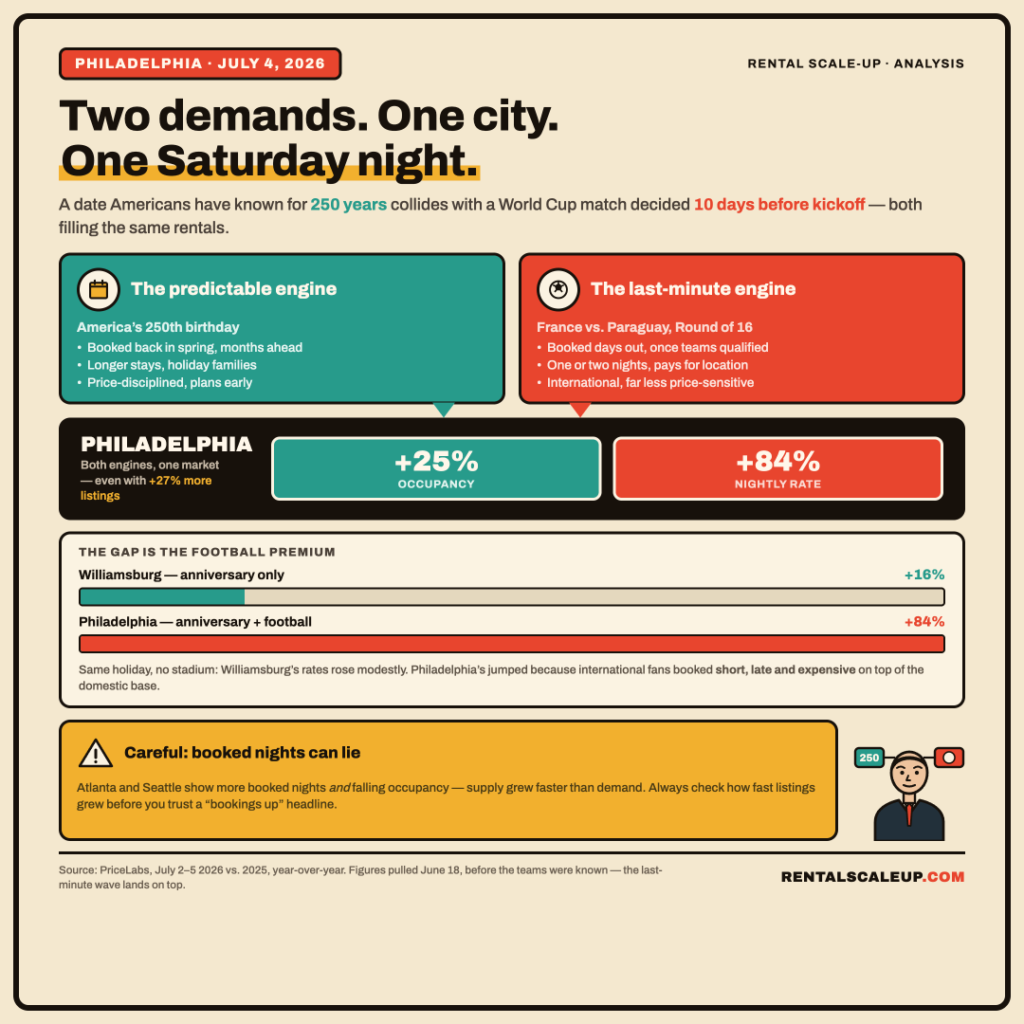
This is the heart of the story, so let’s take it slowly. Two demand engines are filling the same city for the same night, and they could not be more different.
The predictable engine. Domestic American travelers have known the date of this anniversary their whole lives. Philadelphia’s programming — the festival, the time capsule, the fireworks — was announced months, in some cases years, in advance. These guests booked in early spring, often for longer stays, and they chose Philadelphia for the holiday and the history.
The unpredictable engine. FIFA fixed Philadelphia’s Round of 16 slot back in 2024 — but nobody knew which teams would fill it. Football fans could not commit until their team survived. Paraguay only earned its place on June 29, eliminating Germany on penalties (Germany’s first shootout loss in World Cup history). France only confirmed on June 30, beating Sweden 3-0 with two goals from Mbappé. These guests book days before arrival, stay one or two nights, and are far less price-sensitive — the profile we described in our guide to capturing last-minute bookings.
Here is what the two engines produced together, next to markets running on anniversary demand alone:
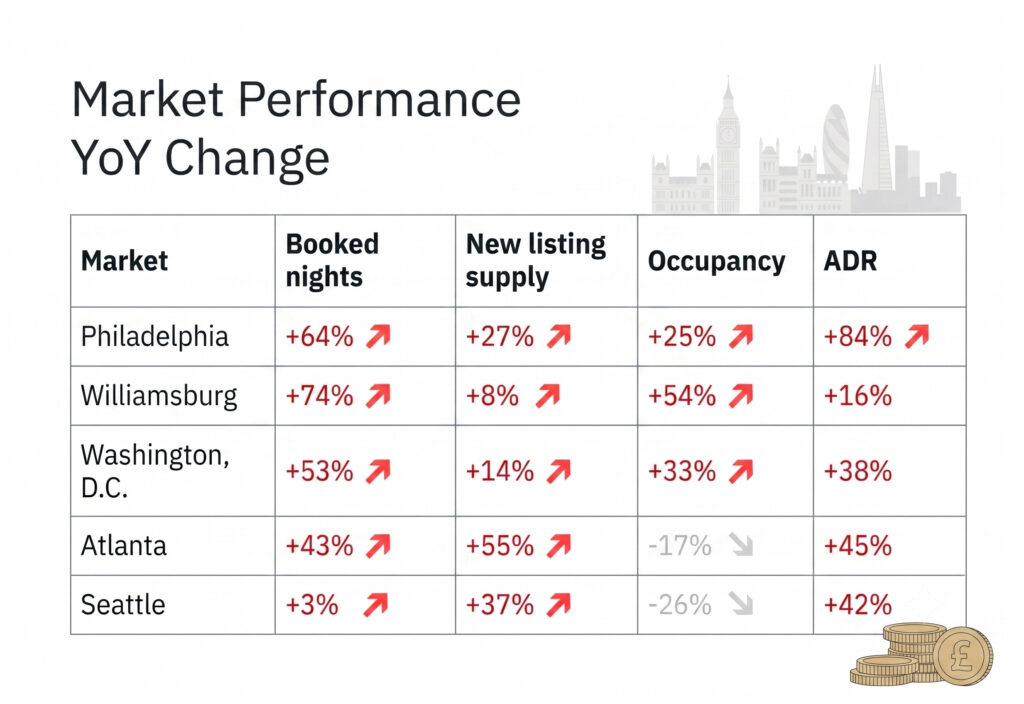
Source: PriceLabs, July 2–5, 2026 vs. the equivalent 2025 weekend, year-over-year change.
Williamsburg — a restored 18th-century colonial town in Virginia, and pure anniversary tourism with no stadium in sight — is the useful comparison. It added almost no supply (+8%) and filled up spectacularly (+54% occupancy), yet its rates rose only 16%. Philadelphia, meanwhile, absorbed 27% more listings, still gained occupancy, and pushed rates up 84%. Our interpretation, and it is only that: the gap between those two ADR numbers is largely the football premium — international guests booking short, late, and expensive on top of a domestic base. (One caveat for the whole comparison: July 4 falls on a Saturday in 2026 against a Friday in 2025, which lifts every market’s numbers somewhat.)
The numbers are from June 18. What has happened since makes them more interesting, not less.
The fact: PriceLabs collected these figures on June 18, when the Philadelphia match was still a blank slot on the calendar. Whatever World Cup demand is inside them came from early planners — fans booking on speculation, hospitality packages, neutral spectators — stacked on the anniversary base. This fits the pattern we saw when the December draw sent demand jumping in some host cities but not others, and again this spring when World Cup bookings stalled while everyone waited to learn who plays where.
What happened since should reshape the picture, and mostly in one direction:
- June 29: Paraguay eliminates Germany. Germany brings one of the largest traveling fanbases in world football; German supporters who had booked Philadelphia on speculation now have no reason to come. We can expect a wave of cancellations — and inventory released two weeks out, into peak demand, tends to get rebooked at higher rates, not lower.
- June 30: France beats Sweden 3-0. France is arguably the biggest crowd-drawing team that could have landed in this slot: a huge traveling support, large French communities in New York and Washington within train distance of Philadelphia, and Mbappé pulling neutrals who simply want to see him play. Paraguayan fans, meanwhile, are scrambling for anything available after a historic upset.
So the +84% ADR growth in the June 18 numbers is probably not the ceiling — it is the base the last-minute wave is landing on. We can expect the June 30–July 4 booking window to push Philadelphia’s rates and occupancy further, and the next data pull to show it. That is speculation on our part, but it is the direction every arrow points.
The revenue management lesson: two demands, two pricing problems
So, should Philadelphia hosts have priced for the World Cup back in March, before knowing the teams? Partly, yes — and that “partly” is the whole lesson. Much of the event-pricing playbook we laid out for the 2024 Paris Olympics applies here. Three rules:
- Long-lead demand rewards rate discipline, not availability. The domestic anniversary guests booked in spring. A host who sold out early at last year’s rates effectively subsidized their holiday. When an event is known years ahead, raise rates early and let the calendar fill slowly.
- Last-minute event demand rewards flexibility. Football guests book days out, stay one or two nights, and pay for location. Keep some inventory back, drop minimum-stay rules as the date approaches, and let dynamic pricing work the final week. A three-night minimum designed for holiday families locks out the two-night football fan willing to pay more per night.
- Never blend the two into one demand curve. Averaging a long-lead domestic guest and a last-minute international one produces a price that is wrong for both. Treat them as separate segments with separate rules — that is what Philadelphia’s +84% ADR growth alongside +25% occupancy growth looks like in practice.
A quick warning from Atlanta and Seattle: booked nights can lie
Not every market with a good headline number is having a good holiday. Atlanta’s booked nights are up 43% — but the city added 55% more listings, and occupancy actually fell. Seattle is starker: booked nights up just 3% against 37% more supply, and occupancy down 26%. This is the supply dynamic we have been tracking since the “Airbnbust” debate of 2022–2023: more listings, demand dispersed, each host filling less. The rate growth both cities show is better-positioned listings holding firm, not a market getting tighter — the same pattern we found in Super Bowl LX rentals, where ADR jumped 2.3x without an occupancy surge. Before believing any “bookings up X%” headline about your own market, check how fast supply grew. The gap between the two is the real signal.
This is not just a US story
The same collision is coming to Europe. Euro 2028 will be played in the UK and Ireland, and the 2030 Winter Olympics land in the French Alps — both layering unpredictable, late-booking international demand on top of whatever local, predictable demand already exists. The platforms are preparing for this too, as we saw in Airbnb’s positioning around the Milan-Cortina Winter Olympics. Any market pricing up around a national anniversary or a mega-event faces the Philadelphia question: is a second demand source stacking on top, or is the event landing alone while supply keeps growing?
The 2026 World Cup itself now moves on: quarterfinals in Boston, Los Angeles, Miami, and Kansas City (July 9–11), semifinals in Dallas (July 14) and Atlanta (July 15), and the final at MetLife Stadium near New York on July 19. Each of those cities gets the same test Philadelphia just passed.
Conclusion
Philadelphia got lucky — Paraguay had to beat Germany on penalties for the most compelling version of this weekend to exist. But the mechanism that made it work, two non-competing demand sources filling one market from different angles, does not require luck to identify in advance. Now, as usual, what matters is your own market: how fast is supply growing there (check the data), and is there a second demand source behind your next big date, or just a headline? PriceLabs’ Market Dashboards will show you the supply picture; your own booking window data will show you the rest.

Thibault Masson is a leading expert in vacation rental revenue management and dynamic pricing strategies. As Head of Product Marketing at PriceLabs and founder of Rental Scale-Up, Thibault empowers hosts and property managers with actionable insights and data-driven solutions. With over a decade managing luxury rentals in Bali and St. Barths, he is a sought-after industry speaker and prolific content creator, making complex topics simple for global audiences.
Related Articles:
 Illegal Price Gouging During LA Fires: Airbnb Implements Host Pricing Restrictions
 Airbnb to Appeal New Orleans Ruling, Expands Compliance Push in Spain, Key Data Launches New Tools in the UK
 How Property Managers Can Adapt to Airbnb’s Host-Only Fee Without Losing Margins
 Airbnb’s Q4 2025 Earnings Call: Top 10 Things FOR Vacation Rental Managers