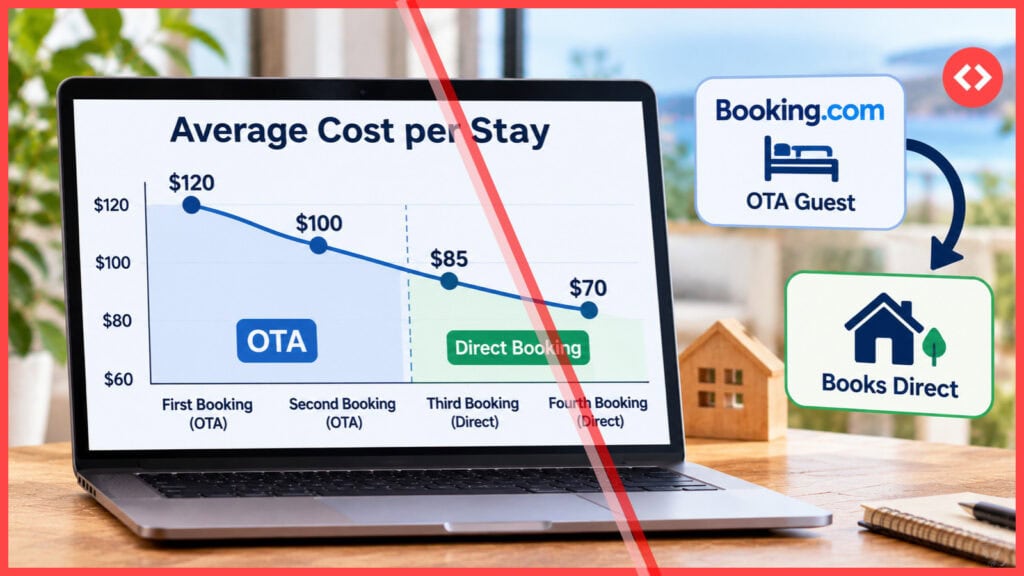
Thibault Masson’s AI method, run on a sample host, suggests a repeat guest who books direct is the cheapest booking a manager can get.
- What changed: Airbnb now charges most hosts 15.5% and Vrbo charges 12%, so the cost comparison between platforms and direct bookings has shifted.
- Who it impacts: Property managers and hosts who run a direct booking site or take bookings by email and social media.
- What to watch: Whether your guests come back, and whether your booking form asks how they found you.
Direct booking is often recommended to short-term rental managers because there is no platform commission and the guest relationship stays with the host. Thibault Masson, founder of RSU by PriceLabs, took that route too, taking bookings through his own direct booking website. At the Direct Booking Success Summit, he tested whether it pays, using a method that counts the cost of every channel, his own included.
He demonstrated the method on a sample host, not his own books. His own villa in Puglia is priced in euros, so he built Blue Ridge Stays for the session: three properties in Asheville and 62 bookings in a year.
His main point: a direct booking is one of three things, and only a repeat guest is cheap. A new direct guest carries the cost of the website and marketing that found them, and can end up costing more than a booking through an online travel agency (OTA).
Why Direct Paid on St. Barts but Not in Bali
Thibault had two villas on St. Barts and one in Bali before selling them in 2026. Guests reached the St. Barts villas three ways: through a local property manager (typically 20% to 30% commission), through his Airbnb listings, or directly.

Direct had its own costs: a website, a virtual assistant for Instagram and a Facebook group, Mailchimp (an email tool) and his evenings. He accepted those costs because the local tourism office told him about a third of visitors come back, so a free island guide collected their emails.
Bali is a bucket-list destination where few people visit twice. He kept a website, since guests searched the villa’s unique name, but stopped the social media and the assistant. With no returning guests to win back, they were not worth the cost.
Four Costs Behind Every Channel
Thibault splits the cost of any channel into four parts:
- Commission: the platform’s fee, charged on the nightly rate and host fees such as cleaning, not on taxes.
- Discounts: promotions and loyalty-program discounts on the listing.
- Payments and risk: card fees, disputes and damage cover, either included in the platform’s fee or carried by the host.
- Fixed costs: website, tools, photos, ads and time, paid whether or not anyone books.
Platforms publish their commission. The fourth is the easiest to overlook, because it never appears on a platform statement.
Here is what each platform charged as of October 2026 (US figures):
| Host fee | Separate guest fee? | Discounts to check | |
| Airbnb | 15.5% for most hosts; 16% in Brazil and Mexico | No | Opt-in promotions and weekly or monthly discounts |
| Vrbo | 12% from October 29, 2026, including payment processing | Yes | Members Only Deals of 12% to 20%, applied automatically from September 18, 2026 unless the host opted out |
| Booking.com | Around 15%, according to Thibault’s slides; higher for Preferred Partners | No | Genius discounts of 10% to 20% |
Booking.com’s Preferred Partner program gives top-performing listings a badge and better placement in return for a higher commission.
Vrbo’s 12% commission also came with new Host Terms that include a parity clause: a rule that a host’s Vrbo rates can be no higher than their rates elsewhere, the host’s own website included. Vrbo has since said it plans to drop the own-website part.
Two Costs Hidden in the Fee
The cleaning fee
Airbnb’s 15.5% applies to the cleaning fee as well as the nightly rate.
Take a two-night stay at $150 a night, plus a $150 cleaning fee. The guest pays $450, and Airbnb charges 15.5% of the full amount: $69.75.
The cleaning fee pays the cleaner, so the host earns $300 from the two nights. Measured against the $300 the host actually earns, the $69.75 fee is 23%. The shorter the stay, the higher that rate gets.
Many pricing tools let you add a channel markup: a percentage added to your price on one channel to cover its fee. Thibault suggests checking that yours covers the cleaning fee, not only the nightly rate. PriceLabs’ help article walks through the markup math. RSU is published by PriceLabs, which sells pricing tools.
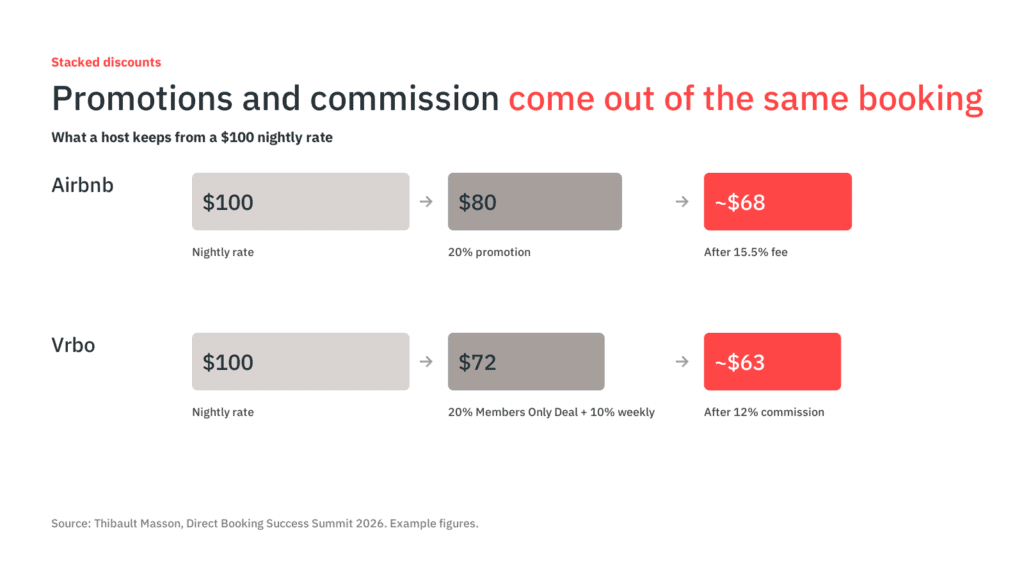
Stacked discounts
A promotion and a commission come out of the same booking, one after the other. Say your nightly rate is $100. A 20% Airbnb promotion brings it to $80, and after the 15.5% fee you keep about $68. On Vrbo, a 20% Members Only Deal plus a 10% weekly discount brings $100 down to $72, and after the 12% commission you keep about $63.
A Direct Booking Comes in Three Types
Thibault sorts direct bookings into three types:
- New guests who found you through Instagram, Google or an ad. They carry the cost of the website and marketing, so they are usually the most expensive booking.
- Repeat guests who came back because you had their email. They carry only small costs, such as the email tool, and are the cheapest booking there is.
- OTA guests who came back direct. Their first stay was on Airbnb or Vrbo, and the next one was with you.
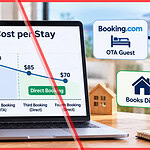
That third group changes how an OTA fee looks. A guest who books once on Airbnb costs 15.5%. If they return once and book direct, paying about 3% in card fees, the average across both stays is 9.3%. If they return twice, it is 7.2%. The first OTA fee works like the price of finding a guest, and its share of the cost per stay shrinks with every return visit.
Two Questions for Your Booking Form
None of this works unless you know which guests are new and which are returning. As his slides put it, averaging all marketing costs across every direct booking gives a number that describes nobody. He suggests two booking-form questions:
- Have you stayed with us before?
- Is this your first time in [destination]?
The first splits new direct guests from repeat ones. The second shows whether your market brings people back, which made the difference between St. Barts and Bali.
How the Method Works
Thibault ran the method in Claude (Anthropic’s AI assistant) on the sample host’s year of OTA exports and bank statements. PriceLabs users can swap the OTA exports for its Bookings Report. Thibault noted the method works without PriceLabs.
His free checklist and prompt cover the setup. The full session and his worked example are in the Direct Booking Success Summit’s All-Access Pass replays. You can also register for future Direct Booking Success Summit events.
Adit’s Read
For me, the most useful idea here is the split between new and repeat direct guests. Much direct-booking math treats “direct” as one channel and compares it with 15.5%. I think that comparison can flatter direct for a small portfolio and undersell it for a manager with loyal guests.
As his slides put it, the OTA buys you the guest. Whether you ever pay less than 15.5% for that guest depends on whether your market comes back, and whether you asked for the email.
Subscribe to the RSU newsletter for weekly analysis for professional short-term rental managers.

Related Articles:
 Airbnb, Booking.com, and Vrbo in 2025: What Property Managers Must Know
 Airbnb, Vrbo, Booking.com: All-In Pricing Is the New Standard
 2026 Travel Trends: Intentional, Emotional, Experience-Led
 Booking.com’s Foundations Score, Vrbo’s Useful AI Chatbot, and Airbnb’s January 18 Booking Peak: the OTA Panel at Short Stay Summit 2026