

This week’s short-term rental policies all reach a key date between December 16 and January 1.
- What changed:
- Hawaii County (the Big Island): Bill 147 would let hosted rentals operate in residential zones without a use permit. It awaits the mayor’s signature.
- Brussels: from January 1, private hosts renting their main home no longer need a planning certificate.
- Toshima (Tokyo): from December 16, minpaku listings can operate only 120 days a year.
- Who it impacts:
- Hawaii County: managers of hosted homes, and of homes taking stays of 30 to 179 nights.
- Brussels: managers of owner-occupied homes. Second homes still need the certificate.
- Toshima: managers of existing minpaku listings, who lose a third of their legal nights.
- What to watch:
- December 16: Toshima’s limits apply.
- December 31: Hawaii County can start enforcing registration, unless the council moves the date.
- January 1: Brussels’ new rules start.
Short-term rental policies in three places reach their deadlines within six weeks: two make room for hosts who rent the home they live in, and one cuts the nights minpaku listings in a Tokyo ward can sell.
Hawaii County Moves to Let Hosted Rentals Operate Without a Use Permit
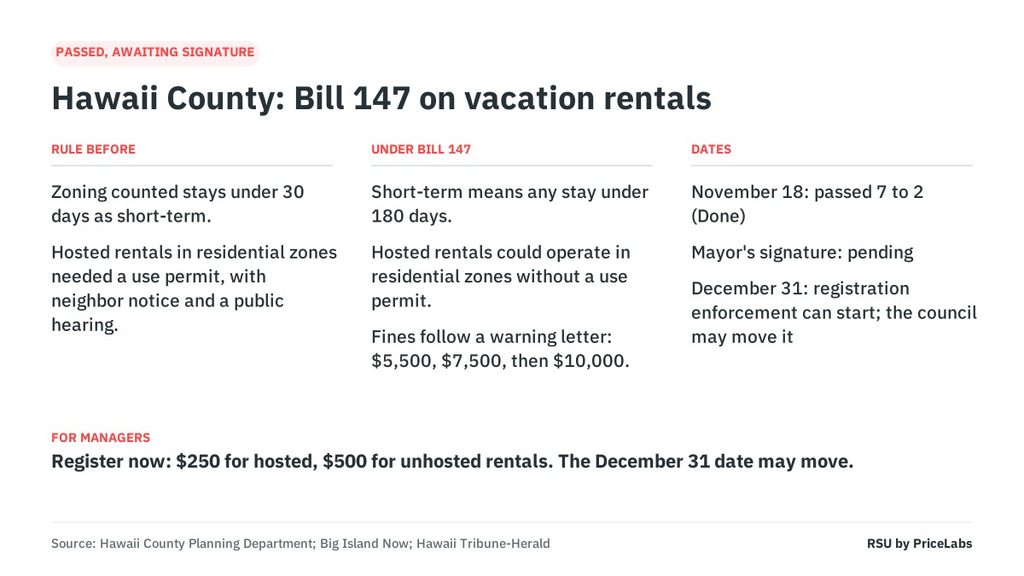
- On November 18, the Hawaii County Council passed Bill 147 on final reading by 7 to 2, rewriting the Big Island’s vacation rental rules.
- Registration opened September 1, and under the old zoning rules every hosted rental registering would have needed a use permit (a zoning approval with neighbor notice and a public hearing), a rule the county had not been enforcing.
- The bill would let hosted rentals, where the host’s principal home is on the property and the host is there during stays, operate in residential zones without a use permit.
- It would count any stay under 180 days as short-term, up from under 30, and limit new unhosted rentals mainly to resort and commercial areas.
- Fines would follow a warning letter: $5,500 for a first violation, $7,500 for a second and $10,000 after that.
- Pending: Mayor Kimo Alameda said he expects to sign it.
- What hosts need to do now: Unregistered rentals need to register on the county’s registration page: $250 for hosted rentals ($100 a year to renew) and $500 for unhosted rentals ($250 a year). Enforcement can start after December 31, but council members have signaled they may move that date into 2027.
Guneet’s Views
- Managers of hosted homes in residential zones could keep renting without a public hearing: The bill removes a permit rule the county was not enforcing, so a registered hosted rental would no longer depend on that choice.
- Managers could check which homes meet the hosted test.
- Under the same 2024 state law, Maui is phasing out apartment-zone rentals while Hawaii County makes room for hosted ones. For managers with homes on both islands, county rules now matter more than the state law.
- Managers taking one- to six-month stays could find those bookings treated as vacation rentals: A three-month winter stay would fall under the same rules as a weekend booking.
- Managers could check which homes take stays of 30 nights or more, whether they are registered, and whether their zone allows that type of rental.
Read more: Hawaii’s phase-out law
Brussels Drops the Planning Certificate for Private Hosts Renting Their Main Home
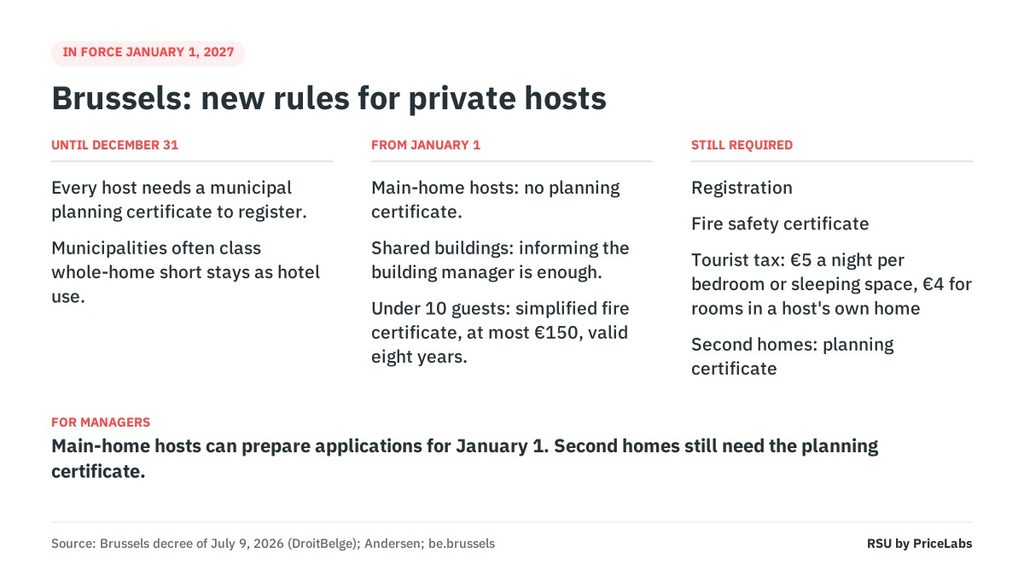
- From January 1, 2027, Brussels applies new rules for tourist accommodation run by private individuals, under a decree adopted July 9 and published October 27.
- A BRUZZ review found at least 90% of the 2,788 entire-home Airbnb listings that hosted guests in 2025, about 2,500 homes, were not registered with the region.
- Until now, every host needed a municipal planning certificate to register, and municipalities often treat short stays in a whole home as hotel use.
- Private hosts renting the home they live in no longer need the certificate, and in a shared building it is enough to inform the building manager.
- The simpler rules cover private hosts with fewer than 10 guests, who can use a simplified fire certificate costing at most €150 (about $165), valid for eight years.
- A tax campaign that has now ended fined unregistered owners €1,000 (about $1,100) per unit and charged back tax as if the home was booked all year.
- Pending: the Brussels Court of Appeal must decide whether the region’s permit system passes the EU Court of Justice’s October 22 test of necessity and proportionality. No date is set.
- What hosts need to do now: Main-home hosts can prepare applications for January 1. Second homes still need the planning certificate. All hosts keep registration and the tourist tax: €5 (about $5.50) per bedroom or sleeping space per night, or €4 (about $4.40) for rooms in a host’s own home.
Guneet’s Views
- Managers of Brussels second homes and investment units could still be refused registration: The change covers only homes the host lives in, and the hotel-use test still applies to the rest until the Court of Appeal rules.
- RSU’s reading of the EU’s proposed Affordable Housing Act found its main-home protection covers only restrictions made on housing grounds.
- For managers, I read both texts the same way: main-home status buys some room, while second homes stay the target.
- Managers of owner-occupied Brussels homes could register them without a planning fight: I think the certificate explains much of why so few whole homes were registered.
- The larger cost of staying unregistered was the back tax, not the fine.
- Croatia went the other way, requiring co-owner consent in shared buildings, so building approval rules belong on each market’s checklist.
Read more: the EU housing draft
Toshima Limits Minpaku Listings to 120 Days a Year From December 16
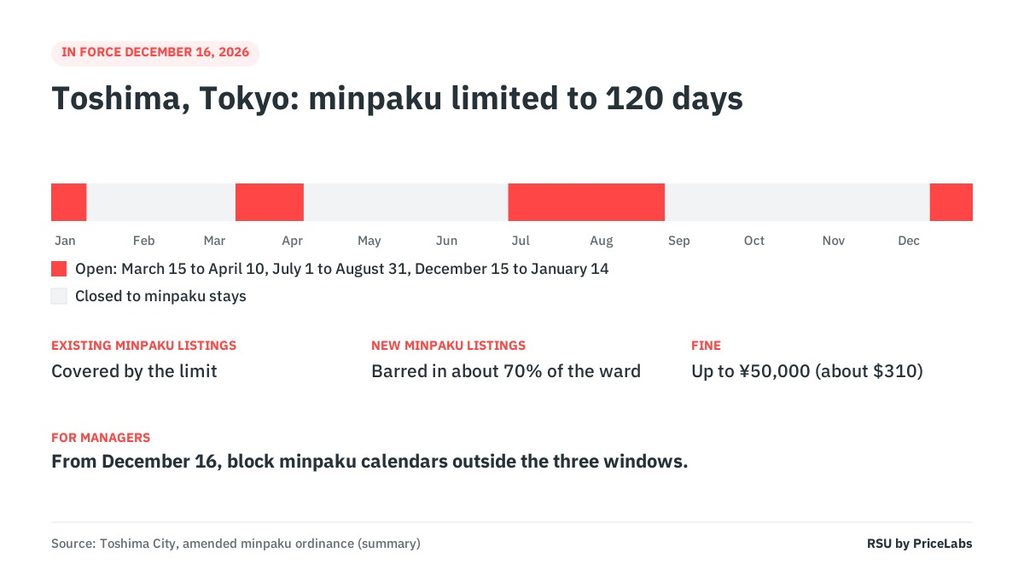
- From December 16, minpaku listings (homes registered under Japan’s home-sharing law) in Toshima, the Tokyo ward that includes Ikebukuro, can operate only 120 days a year, under an ordinance the ward assembly passed unanimously in December 2025.
- The ward cited noise, garbage and smoking: complaints rose from 79 in 2023 to 135 in the first seven months of fiscal 2025, across about 1,850 listings.
- Until now, minpaku hosts could operate up to 180 nights a year under national law. Inn-licensed properties fall under a different law and are not covered.
- Listings, including existing ones, can operate only from March 15 to April 10, July 1 to August 31, and December 15 to January 14.
- New listings are barred all year in about 70% of the ward, and breaking the limits carries a fine of up to ¥50,000 (about $310).
- Pending: the mayor said the ward would consider relief for well-run hosts. Nothing had been announced as of October.
- What hosts need to do now: Block calendars outside the three windows from December 16, and check stays already booked for January 15 to March 14, 2027, since the ward’s summary mentions no exception for earlier bookings. Hosts based abroad need an agent living in Japan.
Guneet’s Views
- Managers of Toshima minpaku listings could lose a third of their legal nights: Short stays end from mid-January to mid-March, mid-April to June, and September to mid-December.
- Managers could check bookings in the first closed period and how prices and minimum stays are set for the three windows.
- Since the national guidance, Bunkyo, Taito, Shibuya and Itabashi have also tightened or proposed tighter rules, so a Tokyo portfolio needs a calendar for each ward.
- Managers weighing a new Toshima listing could find most of the ward closed to minpaku: Toshima has also drafted stricter rules for inn-licensed properties, the usual way around the 120-day limit.
- Managers could check a property’s zoning before taking on a new owner.
Read more: Shinjuku’s residential zone plan

Stay on top of short-term rental regulation trends and what they mean for your listings.

Guneet has spent five years working at PriceLabs, developing deep expertise in short-term rental operations and hospitality technology. She brings that practitioner’s lens to her writing at RSU, covering platform updates and making sense of market data for property managers.
Related Articles:
 Airbnb Under Fire in Spain: What the 66,000 Listing Purge Means
 California’s Crackdown Widens: Beverly Hills Moves to Ban Short-Term Rentals Entirely
 Pennsylvania Advances Caps, Italy Enforces New Tax Rules, Ventura Hikes Fees and Caps Permits
 France 2027 Budget Takes Aim at the Last Big Tax Break for Vacation Rentals