
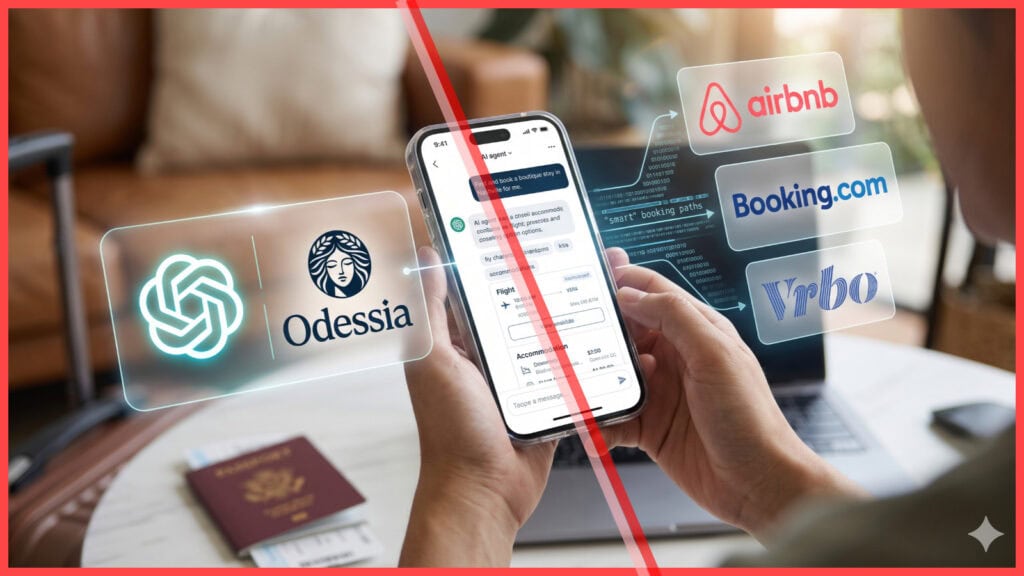
The question: As travelers start planning trips with ChatGPT and other AI assistants, who will control the booking: the platforms you list on, or the AI assistant?
- What happened: On November 10, OpenAI, the company that makes ChatGPT, bought Odessia, a start-up whose AI planned and booked trips itself, and hired its founder, Sonder co-founder Francis Davidson. The deal looks less like buying a business and more like hiring a team.
- The contrast: Days earlier, Airbnb, Booking Holdings and Expedia told investors that AI assistants send them very few bookings (under 1% of the nights booked on Booking.com). That number doesn’t count guests who plan with AI and then book somewhere else, and all three platforms are investing heavily in their own AI.
- Why it matters to you: For now, the AI your guests use most sits inside Airbnb, Booking.com and Vrbo, and it works from your listing details, photos and reviews. Whoever ends up controlling the booking, complete listings and a direct booking website of your own are the safe moves.
More and more travelers ask AI assistants such as ChatGPT or Claude where to go, where to stay and where to eat. So many people in our industry are asking the same question: will guests one day stop going to Airbnb and Booking.com, and let an AI assistant find and book the stay for them? If that happens, whoever runs the assistant decides how guests discover your properties, and what that costs you in commission.
So is the threat real, or overstated? In my view, both signals are true: AI brings the platforms few bookings today, and they are right to take it seriously. Here’s what OpenAI bought, how Airbnb, Booking Holdings (the owner of Booking.com) and Expedia Group (the owner of Vrbo) are responding, and why it matters for how guests find your homes.
What OpenAI Bought: A Team, and a Founder Who Knows Short-Term Rentals
You may know the founder better than the company. Francis Davidson co-founded Sonder in 2014 and grew it into one of the best-known operators in short-term rentals. We followed Sonder for years at Rental Scale-Up (RSU), from the investor deck it used to go public in 2021 to its overnight shutdown, when it announced its liquidation on November 10, 2025, a year to the day before Davidson announced the sale of his next company.
Odessia launched in June 2026 with a team of eight in San Francisco and about $6 million in seed funding led by the venture capital firm Sequoia Capital, according to the trade publication Skift. It opened to the public on October 14 as a free concierge that travelers could reach by text message.

What made it different is that it booked trips itself. That is the difference between an AI assistant, which answers your questions, and an AI agent, which acts for you: it searches, compares and can go as far as booking. Odessia was accredited by IATA, the airline industry body, which let it issue airline tickets like a traditional travel agency, Skift reported. Davidson said that over the summer, before the public launch, travelers were planning trips through Odessia at a rate of more than $60 million a year. That is his own figure, it measures travel planned, not revenue, and it hasn’t been independently verified.
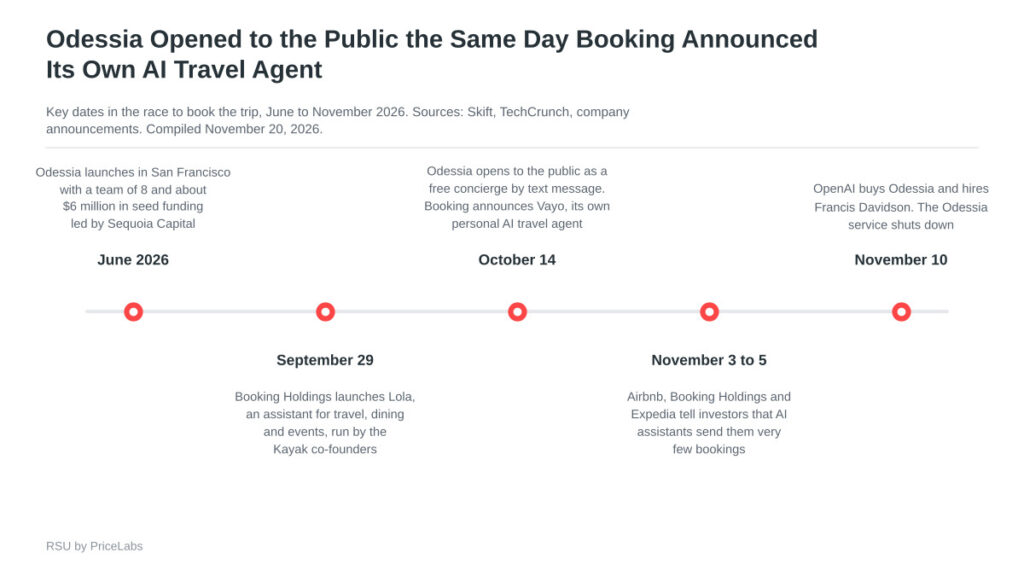
The terms of the deal weren’t disclosed, and the technology news site TechCrunch described it as looking like an acqui-hire, meaning OpenAI mainly bought the team, not the business. Odessia’s service has shut down. Davidson announced the sale himself, in a post on X on November 10, saying he has joined OpenAI “to focus on the future of travel,” and an OpenAI spokesperson confirmed his hiring to TechCrunch. Four days later he described himself as leading travel on ChatGPT, and his public profiles now give his title as Head of Travel at OpenAI.
That is the part I find most interesting for our industry. OpenAI gets people who have built an AI agent that books a trip from start to finish. It also gets a founder who, as Skift put it, knows the economics of lodging from both the guest’s side and the operator’s side. Since Sonder’s business was apartments and short-term rentals, I’d add that his knowledge isn’t limited to hotels.
OpenAI has changed course on commerce before. In March, it scaled back its plans for people to pay for purchases directly inside ChatGPT. And for now, Booking.com and Expedia are both OpenAI partners. Since October 2025, ChatGPT users can search either one through an app inside the chat, and both are taking part in OpenAI’s advertising tests, which we looked at when ads arrived in ChatGPT. So far, OpenAI has bought know-how, not a booking business.
Why This Is a Big Move, Even for a Team of Eight
Until now, ChatGPT has passed travelers on to Booking.com, Expedia or a hotel’s website when it was time to book. Odessia did the booking itself. OpenAI now has people who know how to do that, including a founder who comes from short-term rentals. That matters because rentals have often been an afterthought in AI travel tools: when we tested the travel section of Perplexity, an AI search engine, last year, hotels were on its homepage and vacation rentals were not.
We have also seen this kind of shift before, with Google. When travelers started their trips on Google, the place where they began their search became a toll gate, and the platforms have spent billions of dollars a year on Google ads to stay visible there. Whoever owns the first screen a traveler looks at can charge others for access to that traveler.
What happens next isn’t known, so what follows is our own reading at RSU, not a set of facts. We see three possible outcomes, and each one means something different for a manager:
- The platforms keep the guest. Travelers go on searching and booking on Airbnb, Booking.com and Vrbo, with AI built into those sites. Little changes for you, except that your listing content matters even more, because the platforms’ AI reads it to decide what to show.
- AI assistants become the front door, but book through the platforms. Guests start in ChatGPT and finish on Booking.com or Expedia. The platforms then pay for that traffic, as they do with Google, and that kind of cost has tended to reach managers through higher commissions and paid placement in search results. It’s already starting. Booking.com and Expedia are testing ads in ChatGPT, and Priceline, also owned by Booking Holdings, has just put its AI assistant inside Snapchat ads, where users plan a trip in the chat before booking on Priceline, PhocusWire reported.
- AI assistants book directly. If an assistant can make the booking itself, as Odessia did, your own website and your own data become a real sales channel, provided an AI can read them.
Booking Holdings’ chief financial officer, Ewout Steenbergen, described the arrival of many AI tools as good news for the company, because they give it “an opportunity for diversification” in the sources of its traffic. Our reading: several assistants competing to send guests could make Booking less dependent on any single gatekeeper, Google included.
Are the Platforms Being Bypassed? What Airbnb, Booking.com and Expedia Told Investors
Airbnb, Booking Holdings and Expedia reported their July to September results within three days of each other, from November 3 to 5. On every earnings call, where listed companies present their results to investors, analysts asked the same question: will AI assistants like ChatGPT cut you out?
Booking Holdings said bookings from travelers who arrive through an AI chatbot “still account for significantly less than 1% of Booking.com’s room nights” (a room night is one night booked in one room or home), even though that traffic has picked up in recent weeks. Steenbergen added that, based on data from outside firms, “the vast majority” of the traffic from AI tools is coming to Booking.
Expedia CEO Ariane Gorin described traffic from AI agents as small but high quality. She said these visitors look either new to Expedia or like people who would otherwise have come through Expedia’s paid advertising, not people who would have come on their own. Her view so far is that AI’s “real strength is in discovery,” while “people still want to book with a trusted brand.”
Airbnb CEO Brian Chesky said general AI agents such as Meta’s Muse bring Airbnb few visitors and “even fewer bookings,” a “very non-material number” for a company handling nearly half a million bookings a day. Yet he opened the AI part of his remarks by saying “I believe AI is one of the best things to ever happen to Airbnb.”
There are two ways to read these small numbers. The platforms’ reading is that AI assistants are not taking bookings from them. The other is that some guests are already going around them, and the numbers can’t show it.
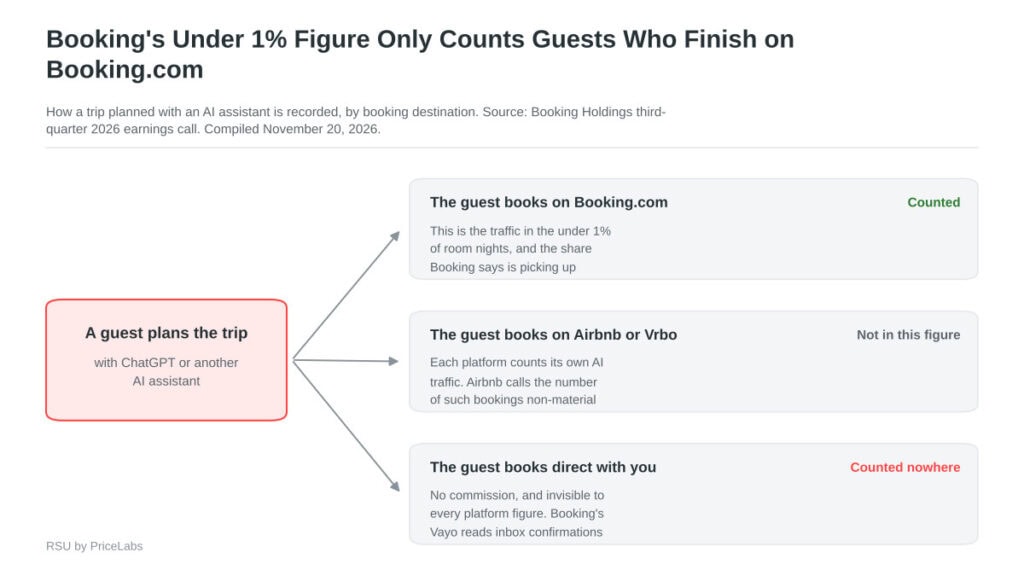
Booking’s under-1% figure only counts guests who arrive at Booking.com from a chatbot and book there. A guest who plans a trip with ChatGPT and then books directly with you shows up nowhere in it, a blind spot we first pointed out in our August piece on that number’s blind spot. Booking Holdings seems to know that: its new AI agent, Vayo, reads guests’ booking confirmations in their inbox, including those for direct bookings, as we noted in our Booking Q3 analysis.
And all three are investing as if those numbers will grow, each with a different bet.
Four Bets on Who Will Control the Booking
Every travel company is asking the same thing: will guests plan and book inside the travel platforms, or inside general AI assistants like ChatGPT? Each is answering differently.
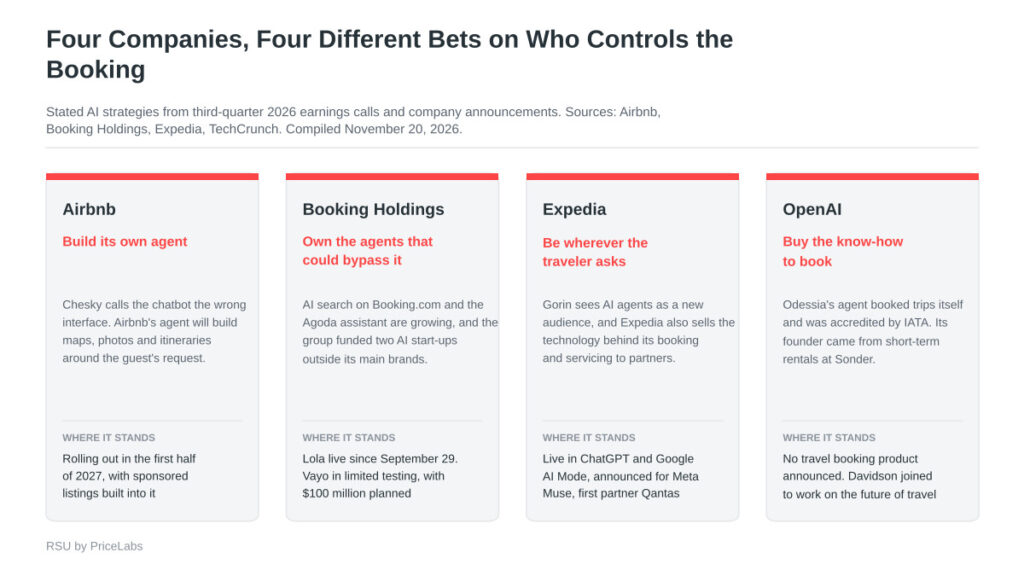
Airbnb is building its own agent. Chesky called the traditional chatbot “the wrong interface” for travel, because guests want to look at photos, compare homes and decide with the people they travel with. Airbnb’s agent will instead build maps, photos, comparisons and itineraries around what the guest asks for, starting in the first half of 2027. Chesky added that Airbnb is developing sponsored listings, which hosts pay to have shown more prominently, and that they will be built into that agent, as we covered in our piece on Airbnb Q3 2026 results. It’s an early example of what owning the screen allows: selling visibility on it.
Booking Holdings is improving its own brands and funding new ones on the side. The AI search on Booking.com and the AI assistant on Agoda, the group’s Asia-focused brand, are both growing. The group also launched two separate AI start-ups this fall, which CEO Glenn Fogel called “testing grounds” whose lessons can be brought back to the larger brands:
- Lola, an assistant for travel, dining and events, run by Kayak co-founders Steve Hafner and Paul English. It launched on September 29.
- Vayo, a personal AI travel agent that builds trips from the booking confirmations in a traveler’s inbox, watches prices and looks beyond Booking’s own brands. Booking plans to invest $100 million in it. It was announced on October 14 and is still being tested with a limited number of users, and it can now book as well as plan, through direct connections with Booking.com, OpenTable and SeatGeek. Every Vayo user gets Booking.com’s top loyalty tier pricing.
To us, this is the most daring of the four bets. If AI agents are going to come between Booking.com and its guests, Booking seems to prefer owning those agents to watching someone else build them. That is our reading, not something Fogel has said in those words, but it’s hard to explain funding two start-ups outside your main brands any other way. It also puts the Odessia deal in a new light. Odessia and Vayo are the same kind of product, a personal AI travel agent that books, and Vayo was announced on October 14, the very day Odessia opened to the public. OpenAI has just hired the sort of team Booking Holdings has been building in-house.
Expedia wants to be wherever the traveler asks. It is in ChatGPT and in Google’s AI Mode (Google’s conversational search), it has announced that it will work inside Meta’s Muse, and Gorin said Expedia sees AI agents “as a new audience.” It also sells the technology behind its booking and servicing to partners that want their own AI agent, starting with the Australian airline Qantas.
OpenAI has bought the know-how to book. It hasn’t said what it will do with Odessia’s team, though Davidson now leads travel at the company.
Behind each bet is an assumption about how much of the planning guests want to do themselves. It’s too early to say which one is right, and there may not be a single winner. What matters for you is what’s already happening on the platforms where your homes are listed.
Why It Matters for Your Listings: The Platforms’ AI Decides How Guests Discover Your Homes
Whoever controls the screen where guests search also controls how they discover your properties. For now, the AI that shapes your bookings isn’t in ChatGPT. It sits inside Airbnb, Booking.com and Vrbo, and it works from what you put in your listing.
All three now let guests search in their own words, and we tested each one:
- Airbnb: In October, we told Airbnb’s AI search we wanted a house in Nashville for that night, traveling with a baby and a dog. Our sentence turned into a destination, dates and filters: “allows pets” switched on by itself, and a crib filter was suggested. When we asked for the worst house on the site, we got nothing. It works less like a chatbot and more like an easier way into Airbnb’s normal search.
- Vrbo: We asked for “pet friendly stays in a place known for intermediate hiking in mid-January.” Vrbo picked Asheville, North Carolina, filled in dates and the pet filter, and showed cards explaining its picks. It’s a test version for now, on Vrbo’s US English website and app, and you can see the screenshots in our piece on Vrbo Q3 2026 tools.
- Booking.com: Its search bar now invites guests to describe what they want in their own words, and on a property page, an assistant called Dot answers guests’ questions from the listing and its reviews. When I tried it this month, it handled practical questions well, but when I asked it to choose a place for me, it wouldn’t.
In every case, the guest still ends up on a page of results and makes the choice there. AI helps guests explain what they want. It doesn’t choose for them, at least not yet.
The platforms are also using AI to describe your home before the guest opens your listing. Airbnb’s AI can summarize a home’s important details in search results, and Expedia has added an “AI compare agent” and a “property expert agent” so guests can compare properties and check amenities without opening each listing.
All of these tools are built from your listing details, photos and reviews. A search can’t match your home to a guest who needs a crib or a fenced yard if your listing doesn’t say so, and an AI summary is only as accurate as what it summarizes.
That’s the part you control, and it holds whichever company ends up owning the screen: a complete, accurate listing is what the platforms’ AI reads today, and what an assistant such as ChatGPT would read tomorrow. The other thing you control is a website of your own. A guest who plans a trip with an AI assistant and then books with you directly is a booking on which you pay no commission, and exactly the kind of booking that Booking’s under-1% figure doesn’t count.
What to Watch Next
Much of what we’ve described is available only in the US for now, and none of the four bets has paid off yet. These are the four signals we’ll be following at RSU:
- Whether OpenAI launches a travel booking product. It hasn’t announced one, but booking trips is what Davidson’s team knows how to do, and Davidson now runs travel there.
- Airbnb’s AI agent, due in the first half of 2027. We’ll look at how it picks the homes it shows, and how much room the sponsored listings built into it take up.
- Booking’s share of bookings from AI assistants. It is significantly below 1% of Booking.com’s room nights today. A move above 1% would be the first sign that guests are changing where they start.
- What Booking does with Vayo and Lola. When they open to everyone, we’ll see whether Booking would rather own the AI agent than be bypassed by one.
OpenAI’s purchase of Odessia doesn’t change where your guests book this month. But the question for 2027 is less whether an AI will book the trip, and more which screen the guest is looking at when they make up their mind.
FAQs
What is Odessia, and why did OpenAI buy it?
Odessia was an AI travel agent founded by Sonder co-founder Francis Davidson. It planned and booked flights, hotels and itineraries by text message, and was accredited by IATA, the airline industry body. OpenAI, the company that makes ChatGPT, bought it on November 10, 2026, mainly for its team, and the service has shut down.
Is OpenAI launching a travel booking service?
It hasn’t said so, but it bought a team whose only product was an AI agent that booked trips, and Davidson, who has joined OpenAI “to focus on the future of travel,” now describes himself as leading travel on ChatGPT.
How many bookings do AI assistants send to Booking.com, Expedia and Airbnb?
Very few so far. Booking Holdings said AI chatbots account for significantly less than 1% of Booking.com’s room nights, Expedia called the traffic small, and Airbnb called the number of bookings from general AI agents “non-material.” These figures don’t count guests who plan with AI and then book directly with a manager.
When is Airbnb launching its AI agent?
Airbnb plans to start rolling it out to guests in the first half of 2027.
What does it mean for vacation rental managers?
Nothing changes this month. Guests still book on Airbnb, Booking.com and Vrbo, and those platforms’ AI tools work from your listing details, photos and reviews, so complete and accurate listings matter more than before. A direct booking website gives guests who plan with an AI assistant a place to book with you.

Thibault Masson is a leading expert in vacation rental revenue management and dynamic pricing strategies. As Head of Product Marketing at PriceLabs and founder of Rental Scale-Up, Thibault empowers hosts and property managers with actionable insights and data-driven solutions. With over a decade managing luxury rentals in Bali and St. Barths, he is a sought-after industry speaker and prolific content creator, making complex topics simple for global audiences.
Related Articles:
 Airbnb’s AI Era Isn’t About Automation, It’s About Emotion and Understanding
 What Airbnb’s New Privacy Terms Reveal About Its AI Plans for Summer 2026
 Sykes Cottages AND Casago/Vacasa on AI: Lessons for Smaller Property Managers from The Short Stay SUMMIT 2026
 We’ve Been Explaining MCP in Theory. PriceLabs’ New AI Connector Lets Us Show You in Practice.