
This week’s short-term rental policies act at the moment a guest books: whether a listing may take the booking, and what tax the stay carries.
- What changed: Booking Holdings launched Vayo on October 14, 2026 with a planned $100 million investment. It connects to a traveler’s email inbox, reads their travel confirmations (including bookings made directly with a property), assembles them into one itinerary and monitors them afterward. On the Q3 earnings call on November 3, chief executive Glenn Fogel said the company had learned that most testers will hand over their whole email history.
- Who it impacts: Any manager who takes direct bookings and sends a confirmation email. The product is United States only and invite-only for now, with general availability expected in the first half of 2027.
- What to watch: Vayo’s terms authorize it to monitor bookings for repricing opportunities and allow its staff to contact suppliers it designates to request a rate adjustment. Whether a direct booking with a small property manager falls inside that designated set has not been stated.
Booking Holdings launched Vayo on October 14, 2026, an start-up Booking Holdings funds that connects to a traveler’s Gmail account and reads their booking confirmations. The company has said it plans to invest up to $100 million in it. Three weeks later, on the November 3 earnings call, chief executive Glenn Fogel was asked what the company had learned from the product so far, and he answered that Vayo had wanted to know whether travelers would connect their whole email history, and that most of them do.
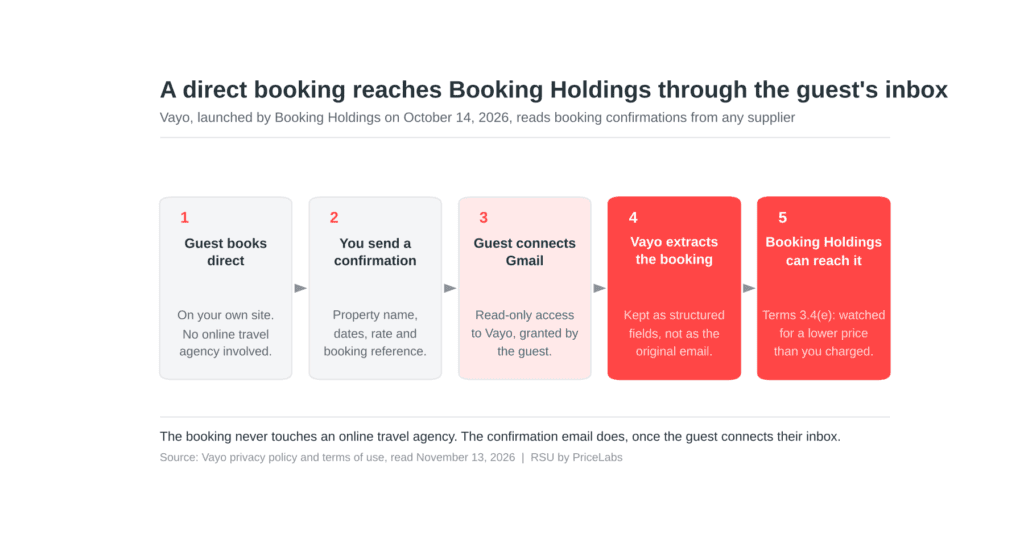
Those inboxes hold confirmations from every supplier a traveler has ever booked with. That includes property managers who sell direct. This is a product from a platform company that takes a direct booking as an input rather than guessing at it from traffic or ad data. It reads the confirmation email you sent, with your guest’s permission, and then keeps watching that booking.
What Vayo Does
Who Built Vayo and Who Can Use It
Vayo is a separate company inside Booking Holdings, based in Seattle and run by Mike Fridgen. It is invite-only and free, open to travelers in the United States aged 18 and over, and limited to one inbox per account. General availability is expected in the first half of 2027.
What Booking Says Vayo Does With a Traveler’s Email History
Fogel described the product in his prepared remarks on the earnings call. Vayo brings existing reservations from a traveler’s email history into one place, he said, and uses that history to create more personalized offers and to suggest ways to fill gaps in an itinerary. He added that it continuously monitors prices and stays engaged after booking, alerting travelers to changes and helping them adjust their plans.

The Inbox Access Is Read-Only and the Traveler Can Revoke It
The inbox access itself is narrow. Vayo’s privacy policy says it connects through Google sign-in with read-only permission, does not alter messages, and does not keep raw message bodies once it has extracted the booking details. A traveler can revoke access in their Google settings at any time.
Vayo Does Not Separate Your Booking From Booking.com’s
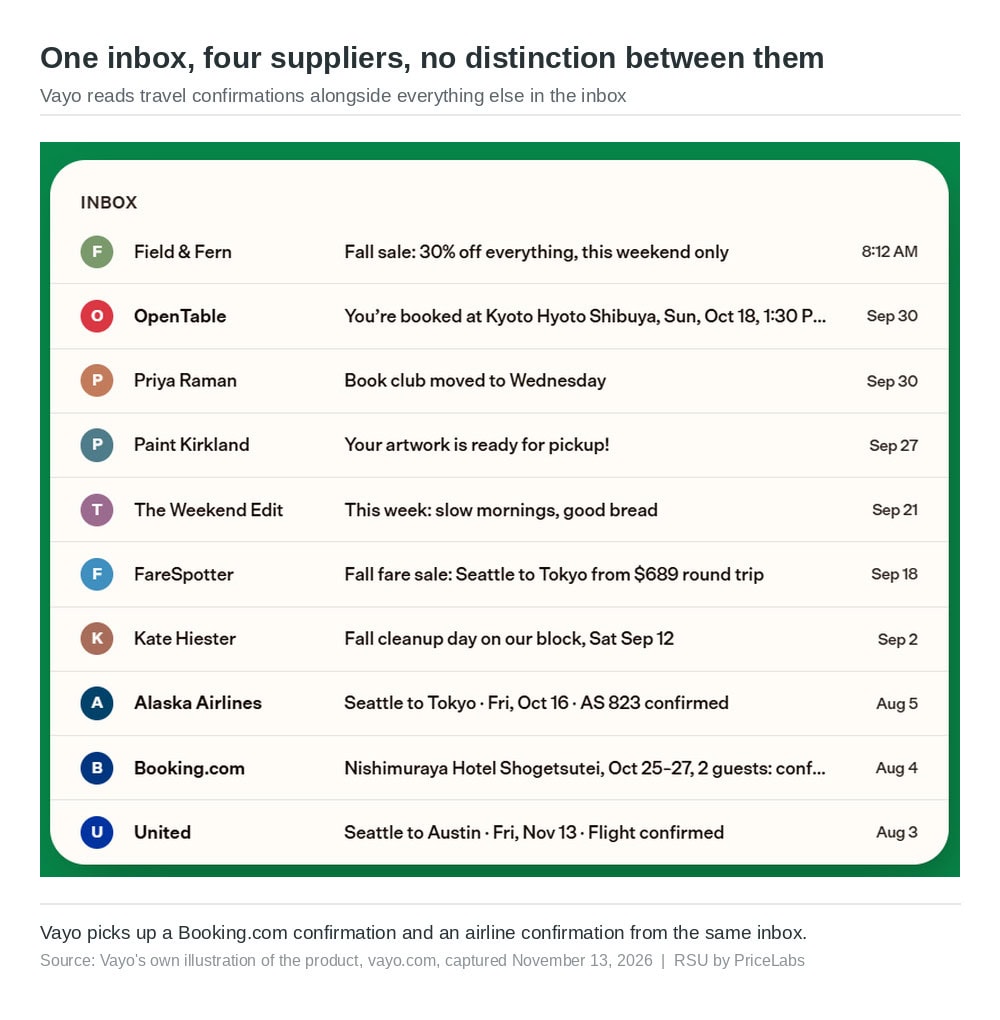
Vayo’s own homepage shows a sample inbox in which an Alaska Airlines confirmation, a Booking.com confirmation and an OpenTable reservation resolve into one trip. The same page promises neutrality about where the traveler books next: if the better room is on the property’s own site, Vayo says that is where it will send them.
Why It Matters to Managers Who Sell Direct
Four things change for a manager who sells direct, and only one of them is about privacy. The other three are about what happens to the booking after your guest has made it.
Your Direct Booking Becomes a Record Inside a Booking Holdings Company
Vayo extracts and stores the property name, dates, rate and confirmation number. In August, Booking told investors that AI tools account for under 1% of its room nights, and we pointed out at the time that the figure has a blind spot: it cannot see the traveler who researched on AI and then booked direct. Asked directly whether AI users were booking with hotels instead of through Booking, Fogel’s answer was “I don’t know, they don’t tell me.” Vayo is a product that can see some of those bookings, from the traveler’s side.
Vayo Works in the Weeks Between Booking and Arrival
If you send pre-arrival sequences, guidebooks or upsells, those messages are where a direct booking earns more than its nightly rate. Fogel said Vayo uses a traveler’s booking history to suggest ways to fill gaps in their itinerary. In our view those are the same gaps you were planning to fill, and Vayo reaches the guest first.
A Confirmed Booking Gets Watched for a Cheaper Rate
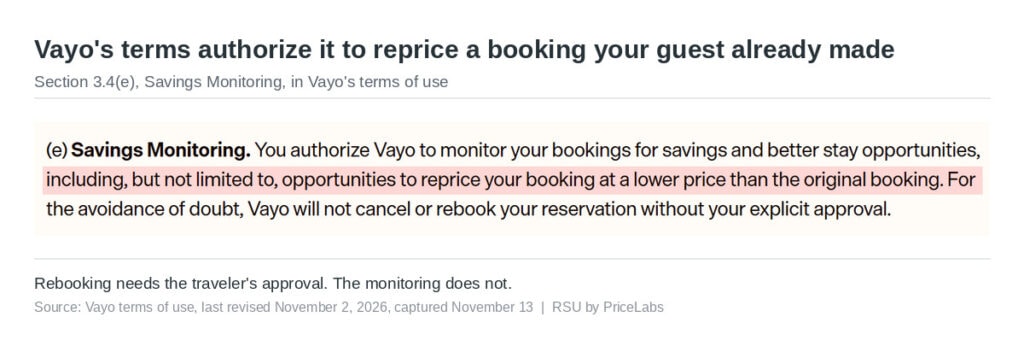
Section 3.4(e) of Vayo’s terms of use, last revised November 2, 2026, has the traveler authorize Vayo to monitor their bookings for savings and better stay opportunities, including opportunities to reprice a booking at a lower price than the original booking. The same clause states that Vayo will not cancel or rebook a reservation without the traveler’s explicit approval.
Vayo’s Terms Allow Its Agent to Use Your Own Booking Site
Section 1.1 of the terms says the agent can complete a booking either through a direct integration or by using browser-based functionality to access and interact with a supplier’s own website or app. Fridgen has told GeekWire that Vayo works through direct integrations rather than by driving a browser, which is how it avoids being blocked the way other agents have been. So the terms permit something the company says the product does not do today. If that changes, what arrives at your direct booking engine is, in our reading, an automated visitor filling in forms.
Managers on the Major Platforms, and Managers Outside the United States
If most of your volume arrives through Airbnb and Booking.com, the exposure is milder and runs the other way: a neutral agent could point a returning guest at your own site, which only helps if that site is legible to software in the first place, the ground covered in our guide to getting found by AI. Outside the United States, nothing changes operationally yet, because Vayo is not available there.
The Questions Booking Has Not Answered
Section 4.4 of the terms says that for certain suppliers designated by Vayo, Vayo personnel may contact the applicable supplier on the traveler’s behalf to request a fare or rate adjustment. Vayo has not published who those designated suppliers are. There is no public basis for saying whether a small management company is among them, and we are not going to assume it.
It has also not said what it does when it identifies a gap around a booking made directly with a property, which is the behavior its homepage advertises when it says Vayo spots what is missing and suggests what fits.
Why This May Not Matter
- Inbox parsing is old. TripIt has read travel confirmations since 2007, Google Travel does it inside Gmail by default, and Kayak Trips has done it for years. If this were going to damage direct bookings, it had two decades.
- The scale is tiny. A closed beta in one country, with no mobile app, changes nobody’s revenue in 2026.
- The terms are restrained for the category. Read-only access, no retention of raw message bodies, revocation through Google, and a stated refusal to rebook without approval.
- The neutrality may be real. Vayo is never the merchant of record and never processes payment, so it earns nothing from the transaction today. An agent that only covered one company’s inventory would not be useful, and Fridgen has said so.
Our Read
In our view, the sequence matters more than anyone’s intent. Vayo has not announced a revenue model, and the two it has publicly discussed are a subscription and some commercial arrangement with suppliers. The version travelers are agreeing to now is free, neutral and small, and it is the version collecting the inbox permission.
Booking is doing two things at once, as it has before. It joined OpenAI’s paid placement test, which Steenbergen framed in August as a natural fit for a company that has spent two decades working out what a click is worth, while continuing to build assistants of its own. Our reading is that it is positioning for the same outcome here, though Booking has not said so.
What to Prepare For
None of this is urgent. These are low-cost things to have in place before Vayo, or something like it, reaches general availability.
- Read your own confirmation email the way software would. Property name, city, check-in and check-out dates, confirmation number and total: are they in plain text, or buried inside an image header? Our technical checklist asks the same question of your website. An email built to be read accurately is the one an agent will describe accurately to your guest.
- Put your cancellation and change policy in the confirmation itself. A guest looking at a cheaper alternative alongside your terms is making a different decision from one looking at a price alone.
- Decide what your pre-arrival sequence is actually for. If its job is logistics, software will do it better. If its job is the upsell and the relationship, it should be doing that explicitly.
- Watch where your direct bookings come from. Traffic with no referrer has many sources, but it is one place agent-mediated bookings may start to show up, and it is a measurement that belongs to you rather than to a platform.
Vayo is free, neutral and small today. What it becomes depends on a business model Booking has not announced yet.

Guneet has spent five years working at PriceLabs, developing deep expertise in short-term rental operations and hospitality technology. She brings that practitioner’s lens to her writing at RSU, covering platform updates and making sense of market data for property managers.
Related Articles:
 Airbnb Launches Co-Host Marketplace in Japan, Vrbo to Delist Poor Listings, Booking.com Bets Big on India and AI
 Booking.com’s Super Bowl LIX Ads Feature The Muppets, Promise Easy Travel for Everyone
 Why Booking.com Suddenly Sounds More Confident Than Airbnb (and Vrbo)
 Sykes Cottages AND Casago/Vacasa on AI: Lessons for Smaller Property Managers from The Short Stay SUMMIT 2026