Since October 2026, Airbnb’s policy says guests and hosts must keep payments for future and repeat bookings on Airbnb, leaving it unclear whether a past guest can book you direct.
- What changed: Before, the rule banned hosts from asking or encouraging guests to move repeat bookings off Airbnb. Now guests share the obligation, and the rule still sets no time limit.
- Who it impacts: Hosts and managers who also take direct bookings, especially from returning guests.
- What to watch: Whether Airbnb clarifies if a guest who rebooks directly, without being asked, falls under the rule.
A guest stays with you on Airbnb, loves the place, finds your website a year later and books direct. Is that a policy violation? Under Airbnb’s off-platform rules as they read until October, the answer was fairly clearly no. However, Airbnb updated its policy in October 2026, and the new wording muddies the waters.
Some in the industry now read the update as meaning that once a guest books you on Airbnb, every future stay with that guest must stay on Airbnb. Arthur Colker, CEO of StayFi (a guest Wi-Fi and marketing platform for vacation rentals), made that case on LinkedIn in mid-November, and hosts and managers have been debating it since. Airbnb’s own text is less clear-cut than that reading, and that lack of clarity is the real issue for anyone who also takes direct bookings.
To see what actually changed, I compared Airbnb’s current policy with archived versions going back to 2022. The rewrite is real, it is recent, and it does widen the wording. But the “repeat bookings” rule itself is years old, and the policy’s examples still focus on hosts steering guests off the platform. What the update doesn’t spell out is how it treats a guest who comes back on their own.
What did Airbnb change in its off-platform policy?
Sometime between October 1 and October 23, 2026, Airbnb replaced its “Off-Platform and Fee Transparency Policy” with a new page called Pricing and payment transparency. The page kept the same web address. Its stated purpose is protection: payments must take place on the platform “to promote transparency and protect guests and hosts,” and the page warns guests that unexpected requests to pay outside Airbnb may be fraudulent.

The biggest shift is who the rule speaks to:
| Before (Aug 2025 to Oct 1, 2026) | After (from October 2026) | |
|---|---|---|
| Who it addresses | Hosts: “By hosting on Airbnb, you agree…” | Both: “Guests and hosts must…” |
| How the rule is framed | A list of prohibited host behaviors | An obligation to keep payments on Airbnb, plus a ban on asking or encouraging off-platform payments |
| Repeat bookings line | “Asking or encouraging users to move current, future, or repeat bookings… off of Airbnb” | “Guests and hosts must keep payments… for current, future, or repeat bookings on the Airbnb platform” |
The archived version from October 1 lists moving repeat bookings off Airbnb as a banned behavior, and every example under it involves someone asking, encouraging, linking or offering a discount. The version archived on October 23 opens with a standalone obligation instead. Asking or encouraging is now a separate clause that follows it.
That difference matters for one scenario in particular: the guest who comes back on their own.
Can a past Airbnb guest book you direct on their own?
The rewritten policy opens with this sentence:
“Guests and hosts must keep payments for mandatory fees and for current, future, or repeat bookings on the Airbnb platform, and may not ask or encourage another user to send or receive payments outside of Airbnb.”
There are two ways to read it. Taken literally, the first half covers the returning guest: it names guests as well as hosts, includes repeat bookings and sets no time limit. On that reading, a past guest who books direct without any prompting from the host is technically breaking the rule. That is the case Colker made.
The second reading follows the examples that come right after it. Every one Airbnb gives is an active step taken through or around the platform:
- Asking to communicate off-platform before booking
- Adding links to listings or messages that take guests elsewhere
- Offering or asking for discounts to book off Airbnb
- Cancelling a reservation to rebook it off-platform
- Extending a stay off Airbnb instead of using the Change reservation tool
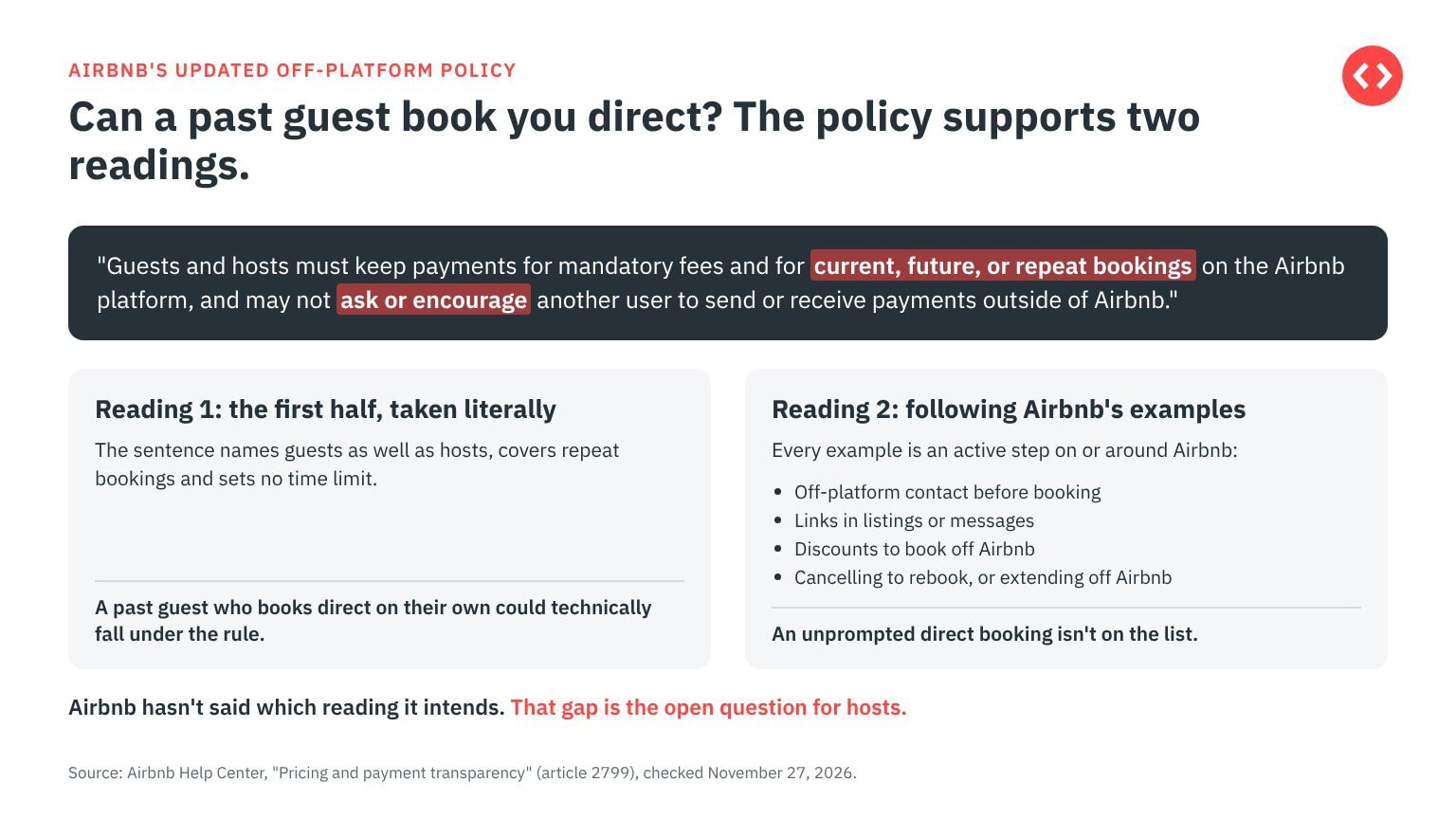
A guest who finds your website on Google a year later isn’t on that list. Several managers made this point in the LinkedIn replies, including Alexander Caravitis, co-founder of channel manager Hosthub, who wrote that he would want Airbnb to clarify the distinction before concluding that “one booking gives them every future stay with that guest, forever.”
Airbnb hasn’t publicly said which reading it intends. The enforcement steps the policy lists, from warnings to listing or account suspension, apply to Airbnb accounts, and the examples all describe activity on Airbnb itself: messages, listings and reservations. Until Airbnb spells out how the rule treats returning guests, hosts with a direct booking channel are working with that ambiguity.
Is Airbnb’s repeat booking rule new?
No. The idea that repeat stays belong on Airbnb has been in the policy for at least four years. The November 2022 version, then titled “Airbnb’s Off-Platform Policy,” already banned “asking or encouraging guests to book outside of Airbnb for repeat or future bookings.” The phrase “current, future, or repeat bookings” arrived in a mid-2025 update.
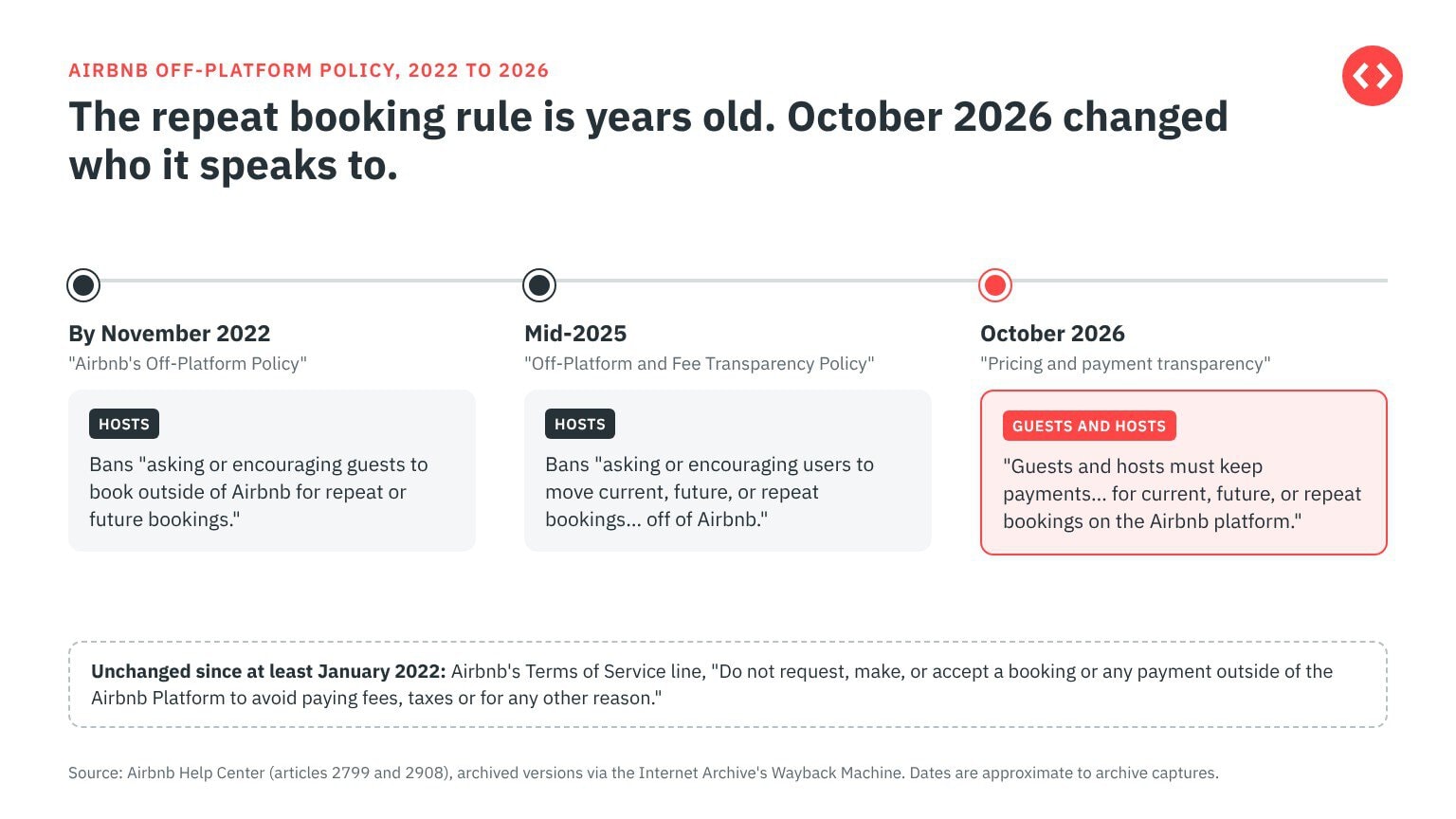
The binding contract hasn’t moved either. Airbnb’s Terms of Service tell users: “Do not request, make, or accept a booking or any payment outside of the Airbnb Platform to avoid paying fees, taxes or for any other reason.” That line appears word for word in every archived version I checked back to January 2022, and the Terms were last updated in February 2026, months before the policy rewrite.
So October’s change is about framing rather than a brand-new restriction. It takes a rule hosts already lived with and restates it as an obligation shared with guests, which is exactly why the returning-guest question now feels open.
What the rewrite means for hosts building direct bookings
Until Airbnb clarifies how the rule treats returning guests, the practical line for hosts and managers with a direct booking channel is the one Airbnb has drawn since 2022: what happens on Airbnb stays on Airbnb. With that in mind, a few things could make sense:
- Reviewing Airbnb messages, templates and listing copy. Automated welcome or checkout messages that mention a website, a discount code or “book direct next time” sit squarely inside the examples Airbnb lists. They’re the most likely place for a violation to show up.
- Keeping extensions on Airbnb. The policy now calls out extensions specifically, and asks hosts to use the Change reservation tool for changes to nights, guests or pets.
- Growing the direct channel from its own sources. Search, social media, repeat guests who first found you directly, and partnerships fall outside the Airbnb relationship entirely. Guests acquired there are the ones a host can market to freely, and working out what a direct booking really costs helps decide how much to invest in them.
It also helps to read this alongside Airbnb’s other recent changes. For reservations booked from November 20, 2026, hosts can’t ask guests for a phone number, email or home address except in limited cases, as RSU covered in its piece on Airbnb’s new contact rules. Taken together, the changes appear to keep more of the guest relationship on Airbnb.
The bigger takeaway is about reading platform policies, not just this one. Help pages can be reworded under the same web address, and small changes in framing can shift what a rule appears to cover. Hosts who rely on more than one channel will likely benefit from rechecking the policies they depend on a few times a year. RSU will keep doing that checking, and we’ll update this piece if Airbnb clarifies how the rule applies to guests who return on their own.
FAQs
Does Airbnb’s off-platform policy cover repeat bookings?
Yes. The Airbnb off-platform policy has covered repeat bookings since at least 2022. The version published in October 2026 says guests and hosts must keep payments for current, future, or repeat bookings on the Airbnb platform.
Can a past Airbnb guest book me directly?
Airbnb hasn’t said. The policy’s opening sentence names guests and covers repeat bookings, but every example it gives involves someone asking, encouraging, linking or offering a discount to move a booking off Airbnb. An unprompted direct booking isn’t on that list.
When did Airbnb change its off-platform policy?
Based on archived versions of the page, between October 1 and October 23, 2026. Airbnb replaced its Off-Platform and Fee Transparency Policy with a page called Pricing and payment transparency, at the same web address.
Did Airbnb’s Terms of Service change too?
No. The Terms of Service line banning bookings and payments outside the Airbnb Platform appears unchanged in archived versions back to January 2022. The Terms were last updated on February 5, 2026.
Keep reading on Rental Scale-Up:
- Airbnb clarifies its house rules: the before and after, and the questions still open
- Airbnb’s temporary phone numbers and new contact rules: what guests gain and managers lose
- Airbnb’s new house rules policy: what hosts can and can’t ask guests to do from November 20
- Direct vs OTA: how to work out what a direct booking really costs
Disclosure: Rental Scale-Up is owned by PriceLabs, an Airbnb software partner.

Uvika Wahi is the Editor at RSU by PriceLabs, where she leads news coverage and analysis for professional short-term rental managers. She writes on Airbnb, Booking.com, Vrbo, regulations, and industry trends, helping managers make informed business decisions. Uvika also presents at global industry events such as SCALE, VITUR, and Direct Booking Success Summit.
Related Articles:
 Airbnb Drops Strict Policy—Limited Takes Over: What It Means for Your Vacation Rental Business
 Airbnb and The White Lotus Effect: A 500% Surge That Rewrote the Market
 Airbnb Touts Experiences 2.0, Booking.com Courts NBA Fans, eviivo Streamlines Checkout with PayPal
 Airbnb’s natural language search is already live in the US — five days before the Summer Release