
This week’s short-term rental policies act at the moment a guest books: whether a listing may take the booking, and what tax the stay carries.
- What changed:
- Montgomery County: platforms would have to collect a county license number and refuse bookings for unlicensed homes, from July 1, 2027.
- Spain: tourist rentals of 30 nights or fewer pay 10% VAT from December 1, 2026, except in the Canary Islands, Ceuta and Melilla.
- South Korea: platforms may not list a stay whose registration they cannot confirm, since November 12.
Three short-term rental policies moved this week at the point of booking: Montgomery County and South Korea make platforms check a host’s license, and Spain adds 10% VAT to each tourist stay.
Montgomery County Moves to Bar Unlicensed Homes From Booking Platforms
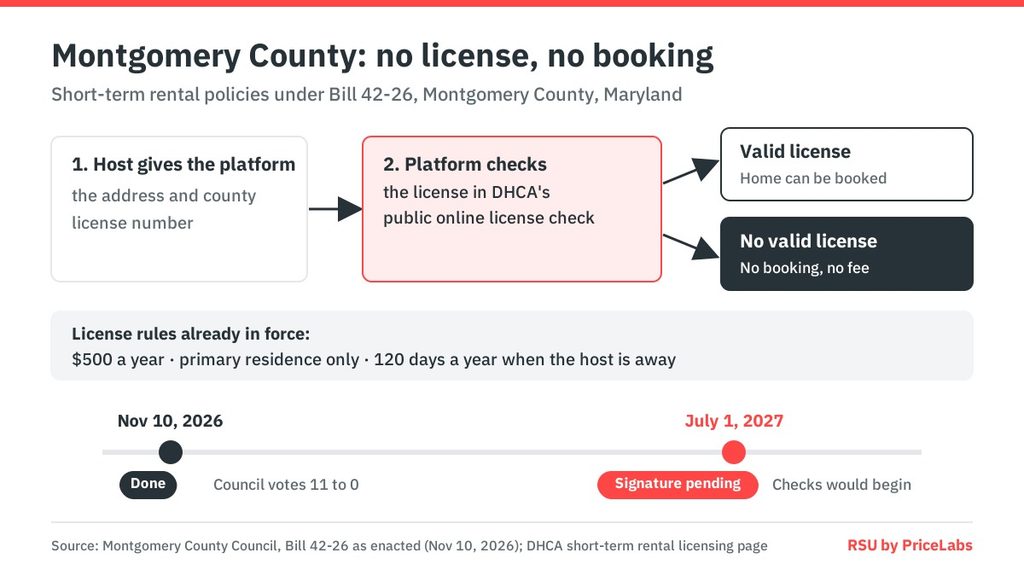
- On November 10, the Montgomery County Council in Maryland voted 11 to 0 to enact Bill 42-26, which puts booking platforms in charge of checking a host’s county license.
- The Inspector General found more than 85% of rentals unlicensed, at a cost of about $1 million a year in lost revenue, and a Halloween party police broke up at a North Bethesda rental on October 31 kept the bill in focus.
- Hosts already needed a $500 annual license from the Department of Housing and Community Affairs (DHCA), the county’s licensing office, for stays under 30 days in their primary residence, with rentals capped at 120 days a year when the host is away, but no rule required platforms to check any of it.
- Before first publishing a listing, a platform would have to collect the home’s address and current license number from the host.
- A platform could not knowingly complete a booking, or collect a fee, for a home without a valid license in DHCA’s public online license check.
- The enacted copy, dated November 10, does not yet carry the County Executive’s signature, and the rules would take effect on July 1, 2027.
- What hosts need to do now: Unlicensed hosts who live in the home can apply for the $500 license now, because DHCA decides applications 30 to 60 days after filing. Owners whose rental is not their primary residence cannot qualify, and would lose platform bookings for stays under 30 days once the rules apply on July 1, 2027. Licensed hosts who rent while away stay capped at 120 days a year, and platforms would also send the county each rental’s occupied dates every year.
Guneet’s Views
- Unlicensed hosts in Montgomery County could lose every platform booking from July 1, 2027: Today an unlicensed listing can keep taking bookings until the county finds it. From July 2027, the platform would ask for the license number before the listing goes live and refuse bookings when the county’s check shows no valid license.
- Managers could check which homes they manage show a current county license, and when each one is due for renewal.
- It could make sense to look at which unlicensed homes already hold bookings for summer 2027, while there is time to apply.
- The Las Vegas area’s platform payment rule and Austin’s platform verification follow the same design: the platform, not the city, stops the booking.
- For managers, the license number starts to work like a key to the listing, so a missed renewal could show up as a blocked listing rather than a warning letter.
- Second homes in Montgomery County can’t get a license, and platforms would now block them: Second homes never qualified for a license. What changes is that platforms would now screen them out before a booking, along with hosts who skipped the paperwork.
- The bill does not change who can get a license. It changes who checks.
- Managers could check which owners live in the home they let and which homes are investment units.
- For homes that cannot qualify, it could make sense to look at stays of 30 days or more, which fall outside the short-term rental license.
- Licensed hosts who rent while away could look at how many away nights they use, since the platforms’ yearly reports of occupied dates would sit next to the 120-day cap.
Read more: Montgomery County’s Bill 42-26
Spain Will Charge 10% VAT on Tourist Rentals From December 1
- On November 12, Spain’s Diputación Permanente, the standing committee that votes for Congress while parliament is dissolved, voted 35 to 34 to confirm Royal Decree-law 29/2026, which replaces the decree Congress rejected on October 2.
- Until now, renting a furnished home to tourists without hotel services was exempt from VAT.
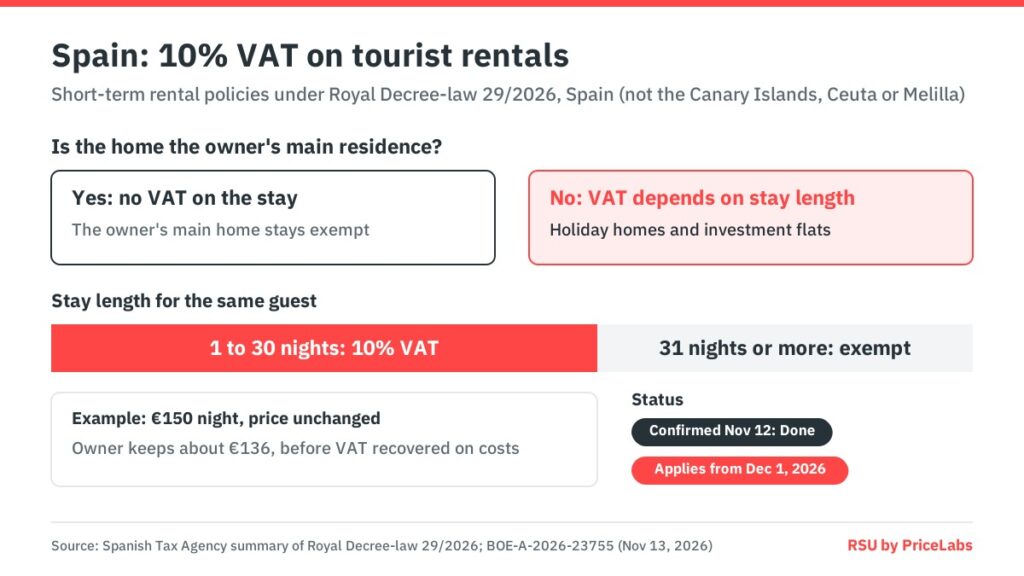
- From December 1, a stay of 30 nights or fewer in a furnished home that is not the owner’s main residence pays VAT at 10%.
- The change does not reach the Canary Islands, Ceuta or Melilla, which sit outside Spain’s VAT law and use their own indirect taxes.
- Separately, councils in stressed housing areas, which are zones declared under Spain’s 2023 housing law, may add a property tax (IBI) surcharge on tourist rentals of up to 50%, rising to 150% for owners of four or more, but only by passing a local ordinance.
- The decree stays in force, and the People’s Party has pledged to repeal it if it governs after the November 29 general election.
- What hosts need to do now: Owners of tourist rentals outside the Canary Islands, Ceuta and Melilla that are not their main home need to register for VAT with the tax office (form 036) and show 10% VAT on the invoice for each stay from December 1. Once registered, they can deduct the VAT they pay on costs tied to the rental, such as management commissions, cleaning and supplies. Owners in stressed housing areas also need to check whether their council has adopted the property tax surcharge.
Guneet’s Views
- Owners in Spain who keep current prices could lose up to about 9% of rental income, less the VAT recovered on costs: The tax sits on the stay, so it either goes onto the guest’s price or comes out of the owner’s revenue. On an unchanged price, about one euro in eleven goes to the tax office, but the VAT owners can now deduct on commissions, cleaning and supplies brings part of it back.
- Managers could check which owner contracts set a nightly price that includes taxes, and who carries the new tax under each one.
- It could make sense to look at how much VAT each owner pays on costs today, because a home with high commissions and cleaning bills recovers more of the 10%.
- Managers could also ask a tax adviser how stays booked before December 1 but paid later are treated.
- Owners of four or more tourist rentals in stressed housing areas could face property tax surcharges of up to 150%: The surcharge grows with the number of tourist rentals an owner holds, and each council decides whether to adopt it. Larger portfolios carry the highest cost.
- Managers could check how many tourist rentals each owner holds, and which of those homes sit in stressed housing areas.
- It could make sense to follow council tax ordinances in the cities where a portfolio is concentrated.
- Italy treats hosts with three or more rentals as businesses needing VAT numbers.
- For managers, both rules tie the tax bill to portfolio size, so the cost of adding a home could jump once an owner crosses the threshold.
Read more: Spain’s reissued housing decrees
South Korea Bars Unregistered Homes From Every Booking Platform
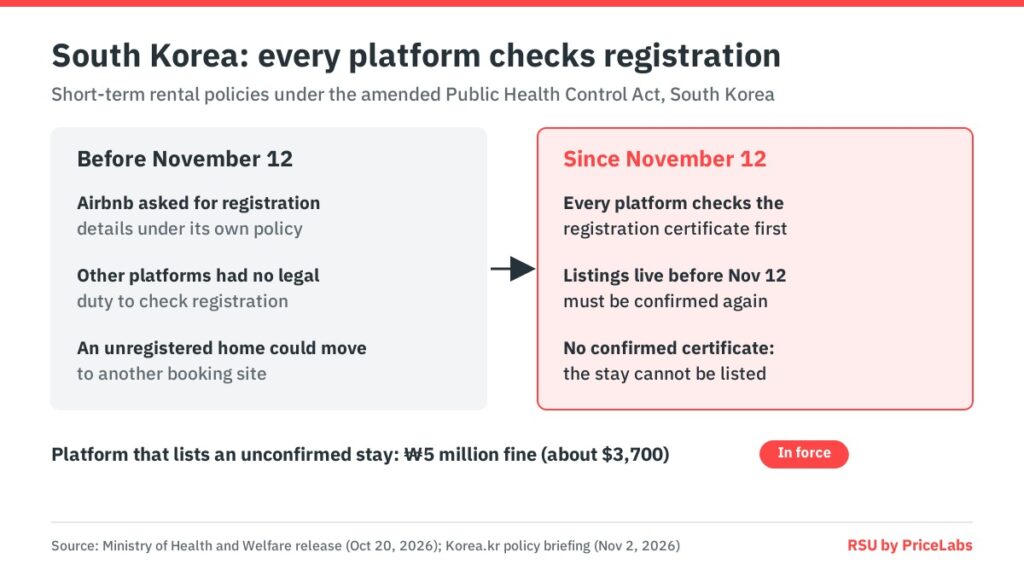
- Since November 12, South Korea’s amended Public Health Control Act bars online platforms from listing a stay whose registration certificate they have not checked.
- The Ministry of Health and Welfare said unregistered lodging sold through platforms is spreading, so platforms need a minimum duty to check.
- Until now, Airbnb asked Korean hosts for registration details as its own policy, and no law required other platforms to do the same.
- Every platform, including online travel agencies and sites that display other agencies’ listings, must check the certificate that matches the type of stay before listing it, and must not list a stay it cannot confirm.
- Stays listed before November 12 must be confirmed again for a platform to keep selling them.
- The rule is in force, and a platform that lists an unconfirmed stay faces a ₩5 million fine (about $3,700).
- What hosts need to do now: Registered hosts need the certificate for their type of stay ready to upload on every platform they use, including listings that were live before November 12. For an urban homestay for foreign tourists (the registration many city hosts of foreign guests hold), that is the tourism business registration certificate from the district office. Unregistered hosts cannot be listed on any platform until they register with their local district office.
Guneet’s Views
- Unregistered hosts in South Korea could lose their listings on every booking site, not only Airbnb: Airbnb’s own rule removed unregistered homes from one platform. The law extends the check to every site, so moving an unregistered home to another channel stops working.
- Managers could check which homes they list on sites other than Airbnb, and whether each one has a certificate on file there.
- It could make sense to look at how much of each home’s revenue comes from channels that never asked for a certificate before.
- The EU’s platform data rules also put the platform at the center of enforcement.
- For managers, the registration certificate becomes a channel requirement held per listing, much like a payout account.
- Registered hosts in South Korea could lose bookings on listings that were already live: The re-check covers listings that were online before November 12. A registered home can still drop out if a platform cannot confirm its certificate.
- The fine falls on the platform, not the host. The host’s cost is the lost listing.
- Managers could check that the business name and address on each certificate match the listing on every channel.
- New York City checks registration at sign-up and stops there, while South Korea asks platforms to confirm listings that were already live.
- For managers, compliance is tested again on old listings, not only new ones.
Read more: Baguio’s no-registration, no-listing plan

Stay on top of short-term rental regulation trends and what they mean for your listings.

Guneet has spent five years working at PriceLabs, developing deep expertise in short-term rental operations and hospitality technology. She brings that practitioner’s lens to her writing at RSU, covering platform updates and making sense of market data for property managers.
Related Articles:
 Arizona Mayors Seek Rental Control, Murcia Partners with Airbnb, and Minut Automates Energy Savings with Ecobee
 How Multi-Model Flexibility Can Help Property Managers Reduce the Impact of Regulations
 Airbnb Partners With CookUnity, Viral Listings Highlight Demand Trends, San Diego Proposes UPTO $12,000+Tax
 Ireland Launches National Register, Vienna Hikes Tourist Tax, Madison AL Caps Permits